Verdict: Vegas Infinite is a polished social VR casino built around multiplayer poker and a wider collection of simulated casino games, including roulette, slots, blackjack, and craps. Its strongest feature is not the number of games but the feeling of sharing a table with other people: tracked hand movements, voice chat, avatars, props, and table etiquette make it closer to a virtual casino lounge than a conventional menu-driven game.
The application is free to download on supported platforms and uses virtual chips rather than cashable gambling balances. Optional purchases and platform-specific restrictions still matter, however. Players should verify the current store listing for their headset, region, age requirements, in-app purchase options, and available modes before installing.
Vegas Infinite review verdict and evaluation scope
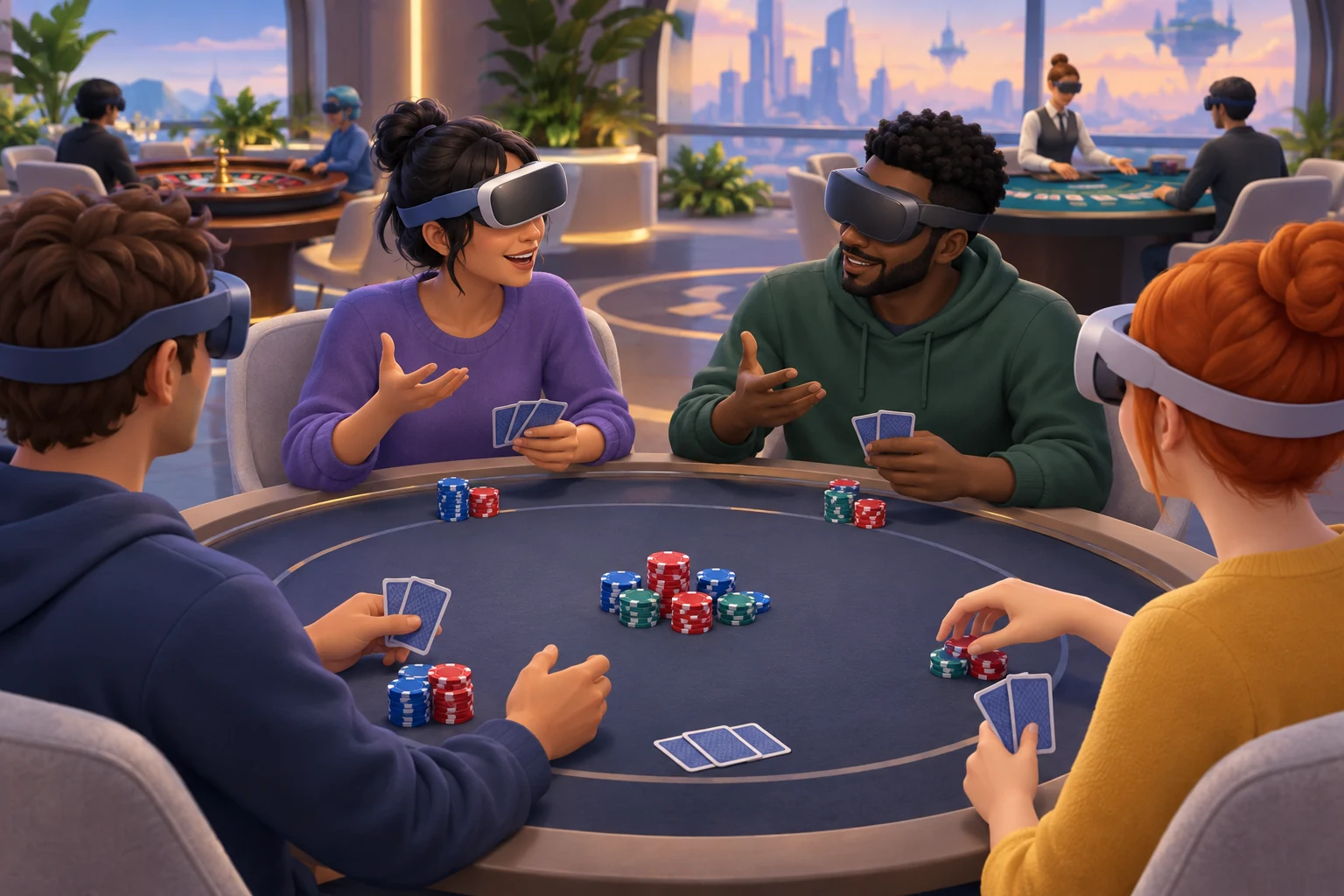
Vegas Infinite is best suited to adults who want casual poker or casino-style entertainment in a social VR environment. It is less suitable for anyone seeking real-money gambling, a private single-player campaign, or a strictly competitive poker client without conversation and virtual-table theatrics.
| Review criterion | Assessment |
|---|---|
| Best for | Social VR players, casual poker groups, and adults interested in simulated casino games |
| Core strength | Convincing multiplayer presence around interactive tables |
| Main attraction | Poker, supported by roulette, slots, blackjack, craps, and other rotating experiences |
| Access model | Free download on supported platforms, with virtual currency and optional purchases |
| Real-money gambling | Vegas Infinite should be treated as a social casino simulation, not as a verified real-money casino |
| Biggest limitation | The experience depends heavily on other players, voice-chat quality, moderation, and device availability |
| Comfort considerations | Seated play is practical, but headset comfort, controller tracking, and motion tolerance still affect longer sessions |
| Overall verdict | A strong choice for social casino-style VR, provided the virtual economy and public multiplayer environment match your expectations |
How this review is qualified
Device support, store availability, purchases, age ratings, and individual game modes can change independently. A feature may exist in Vegas Infinite without being available on every headset or in every region. Platform holders may also apply different account, payment, or parental-control rules.
For that reason, this review distinguishes between:
- Product features: Activities and systems associated with Vegas Infinite as an application.
- Device access: Whether a particular headset can currently install and run it.
- Regional availability: Whether the relevant platform store distributes it in the player’s country.
- Purchasable content: Offers shown through a specific store, account, or version.
- Session availability: Tables, events, or modes that may depend on population, scheduling, or updates.
Before downloading, check the official listing on the same account and headset you intend to use. That listing is more reliable than assuming that support on one VR platform guarantees support elsewhere.
Installation, onboarding, and device support
Installation is broadly similar to other multiplayer VR applications: find Vegas Infinite in the appropriate platform store, confirm that the listed hardware and account meet its requirements, download it, and complete the in-app introduction.
The practical barrier is not usually the installation itself. It is making sure that the correct platform edition, controllers, play space, audio settings, and account permissions are ready before joining a public table.
Pre-installation checklist
Confirm the following before downloading:
- The store page explicitly lists your headset or VR platform as supported.
- Your system has enough available storage for the current build and future updates.
- Your controllers are paired, charged, and tracking correctly.
- Voice-chat permissions are configured according to your preference.
- Your account meets the store’s stated age and regional requirements.
- You understand that chips and cosmetic purchases are virtual items, not cash balances.
- You have a stable internet connection for public multiplayer.
- You can play seated without striking furniture when reaching across a virtual table.
Readers still choosing hardware can consult the broader guide to VR headsets and platform differences.
Supported VR platforms: what to verify
Vegas Infinite has appeared across major standalone, PC-connected, and console VR ecosystems. Support should nevertheless be checked at store level because individual headset models can be added, restricted, or retired.
| Platform type | What the player needs to verify |
|---|---|
| Meta Quest | Confirm that the exact Quest model is named or accepted by the current Meta store listing |
| PC VR through Steam | Check the operating system, PC specifications, runtime, connection method, and headset compatibility shown on Steam |
| PlayStation VR2 | Confirm the PlayStation 5, PS VR2, controller, account, and online requirements on PlayStation Store |
| PICO | Check both the specific PICO headset and regional store availability |
| Other or newly released headsets | Do not assume compatibility; look for an official Vegas Infinite listing or announcement |
A version being available on one platform does not guarantee cross-platform feature parity. Updates, visual settings, input behavior, account systems, and purchase offers may differ.
Onboarding and first-session setup
A sensible first session should focus on controls and safety rather than immediately entering a busy poker table.
- Complete the tutorial or introductory prompts. Learn how to interact with chips, cards, table controls, and menus.
- Adjust your seated position. Recenter the VR view so the table is at a comfortable height and distance.
- Review audio settings. Set voice-chat and player volume before joining a public room.
- Locate social controls. Find the available mute, block, report, or personal-space options in the current version.
- Choose a low-pressure activity. Start with a casual or lower-stakes virtual table while learning the interface.
- Avoid unnecessary purchases. Use the initial free experience to decide whether the application is comfortable and enjoyable.
- Take an early break. The seated format can make long sessions feel effortless even when the headset is becoming uncomfortable.
The onboarding succeeds when it teaches object interaction without making the player think about controller mappings. Picking up cards, moving chips, selecting bets, and using table controls should feel physical. When tracking is unreliable or the table height is wrong, that same physical design becomes frustrating.
Games and gameplay experience
Vegas Infinite presents casino games as shared VR spaces rather than flat betting screens. Players sit or stand around interactive tables, handle virtual objects, observe other avatars, and communicate through voice chat. That design creates the application’s identity, but it also means the quality of a session depends on the people in it.
The game selection should be viewed as a collection within one social application—not as a replacement for specialist poker software or a complete survey of every casino format.
Poker
Poker is the clearest reason to choose Vegas Infinite. The table format translates naturally to VR: players look toward one another, handle cards and chips, react with gestures, and speak as they would during a casual home game.
The format works particularly well because poker contains pauses. Those pauses create room for conversation, observation, and playful interaction. In a conventional digital client, waiting between decisions can feel like dead time. In VR, it becomes part of the social experience.
What works well:
- Physical chip and card interaction gives actions more weight than clicking buttons.
- Head and hand movement help players feel present at the same table.
- Voice chat supports casual table conversation.
- Avatars and props give sessions a recognizable social identity.
- The seated layout is intuitive for players familiar with card rooms or home games.
Potential drawbacks:
- Public-table conversation may distract players who want focused strategy.
- Deliberate stalling or disruptive behavior can slow a session.
- Physical gestures do not provide reliable strategic information in the way real facial expressions might.
- Interface familiarity does not replace knowledge of poker rules.
- A poor microphone or noisy environment can affect everyone at the table.
Poker players who want more context on this specific format can visit the guide to free VR poker games. That page covers the genre, while this review remains focused on Vegas Infinite itself.
Roulette
Roulette benefits from VR spectacle. A shared wheel, visible betting surface, and group reaction to the result create a stronger sense of occasion than a solitary digital interface.
The interaction is straightforward: players select positions on the layout, place virtual bets, and wait for the wheel outcome. The accessibility of the rules makes roulette useful for new users who want to become comfortable with table controls without learning poker strategy.
Its limitations are equally clear. The underlying loop is repetitive, and the result does not require continuous player decision-making. The social environment and presentation therefore carry much of the experience. Players who mute the room and ignore the other participants may find less reason to use VR for roulette.
Slots
Slots provide a faster and more individual activity within the broader social setting. They require less coordination than a table game and can be useful when a player wants a brief session rather than a full poker commitment.
VR allows slot machines to be presented as objects within a casino environment instead of isolated panels. Animations, spatial audio, controls, and themed presentation can make the act of playing feel more tactile.
However, immersive presentation does not change the basic nature of slots. Outcomes remain chance-driven, and repeated play can become mechanically simple. Players should pay particular attention to virtual-currency spending because rapid rounds can make chip losses less noticeable than at a slower table.
Blackjack and craps
Blackjack offers a middle ground between poker’s social decision-making and roulette’s chance-led spectacle. Rules are relatively quick to understand, rounds move briskly, and the dealer-table format fits VR well. The player still makes choices, but there is less interpersonal strategy than in poker.
Craps is more communal and visually active. A shared table can generate group excitement, but the layout and betting vocabulary may be difficult for a newcomer. Players should use any available instructions or low-pressure learning options before committing large amounts of virtual currency.
These modes add variety, but poker remains the activity most clearly enhanced by persistent social presence.
Interaction and user experience
Vegas Infinite’s interface has two jobs: simulate physical actions and provide dependable game controls. Those goals occasionally conflict.
Physical interaction is most effective when:
- Chips are easy to select and place accurately.
- Cards can be viewed without exaggerated hand movement.
- Menus remain accessible while seated.
- Important actions provide clear visual or audio confirmation.
- Accidental grabs or bets are difficult to make.
- The table remains readable on the headset’s display.
The experience becomes weaker when decorative items obscure the table, another player’s behavior becomes intrusive, or tracking errors interrupt a time-sensitive action. VR adds atmosphere, but it also adds more potential failure points than a conventional screen interface.
A player interested only in fast hands per hour may prefer a traditional non-VR card client. Vegas Infinite makes more sense when presence and interaction are part of the desired entertainment.
Virtual chips, purchases, and progression
Vegas Infinite uses virtual currency to support simulated wagering. The essential distinction is simple: virtual chips are game resources, not a cash bankroll.
What virtual chips mean
Virtual chips can be used to enter or play supported casino-style activities inside the application. They may be awarded through the game, obtained through promotions or recurring systems, or offered through purchases depending on the current platform and version.
Players should not assume that chips:
- Represent legal tender.
- Can be withdrawn to a bank or payment account.
- Can be exchanged for a guaranteed cash value.
- Carry across every platform or account arrangement.
- Will be restored after an accidental or unsuccessful wager.
- Have identical purchase prices in every country.
A social casino can still create a strong sense of risk because the chips appear valuable within the experience. VR reinforces that feeling by making stacks, wagers, and losses physically visible. It is therefore sensible to treat optional spending as entertainment expenditure and set a fixed limit before entering the store.
Optional purchases
The exact contents and prices of purchase offers can vary. Depending on the platform and current version, offers may involve virtual currency, cosmetic items, props, or bundles.
Before buying anything, check:
- What the purchase contains. Distinguish playable chips from cosmetics or other account items.
- Whether the item is consumable. A virtual-currency pack may be depleted through play.
- Which account receives it. Confirm that the correct platform profile is active.
- Whether it transfers between devices. Cross-platform play does not automatically mean cross-platform ownership.
- The refund policy. Platform-store rules may treat consumed virtual items differently from ordinary software.
- Local taxes and currency. The final checkout amount may differ from an advertised headline price.
- Payment protections. Use platform purchase controls if other people can access the headset.
The free download removes the initial price barrier, but it does not make every part of the economy cost-free. Players can evaluate the controls and social environment before deciding whether any purchase adds meaningful value.
Multiplayer and social experience
Multiplayer is Vegas Infinite’s defining feature. Other players are not merely opponents represented by names and profile pictures; they appear as embodied avatars around the table. Voice, gaze direction, hand movement, and reactions create a sense of co-presence that conventional casino games rarely match.
Why multiplayer works
The social design is particularly effective for:
- Friends who want a shared activity without meeting physically.
- Casual players who enjoy conversation as much as the game.
- Poker sessions where pauses naturally support interaction.
- Users who like avatar expression, props, and playful table behavior.
- Adults seeking a virtual lounge rather than a solitary simulation.
Private or friend-based play is likely to produce the most predictable experience when the current version provides the required room options. Public matchmaking offers convenience and variety, but the behavior and communication style of strangers cannot be guaranteed.
Public-table risks and etiquette
Public voice chat introduces familiar online-community problems. Players may encounter unwanted language, background noise, attempts to provoke reactions, disruptive props, or people who ignore the pace of play.
Before joining public rooms, players should know how to:
- Mute an individual.
- Reduce or disable voice chat where supported.
- Block unwanted interaction.
- Report conduct that violates platform or application rules.
- Leave a table without continuing an uncomfortable session.
- Protect personal information during conversation.
Do not share a real name, location, contact details, financial information, or account credentials at a table. An avatar’s friendly behavior does not verify the identity of the person controlling it.
Good table etiquette also improves the experience for everyone:
- Make decisions within a reasonable time.
- Keep background audio away from the microphone.
- Avoid placing objects where they obstruct another player’s view.
- Do not pressure other players to buy chips or continue playing.
- Explain rules without mocking beginners.
- Leave rather than escalating an argument.
Advantages and limitations
Advantages
- Strong sense of presence: Shared tables make multiplayer feel more personal than a flat-screen lobby.
- Poker is a natural fit for VR: Cards, chips, gestures, and conversation translate well to tracked controls.
- Several activity types: Roulette, slots, blackjack, and craps provide alternatives to poker.
- Free initial access: Players can assess comfort and social fit before making optional purchases.
- Useful for remote groups: Friends can meet around a recognizable activity rather than in an open-ended social space.
- Seated-play potential: Most table activities do not require a large room-scale area.
- Expressive interaction: Avatars and virtual objects can make repeated sessions feel less mechanical.
Limitations
- The virtual economy may encourage spending: Free access does not eliminate optional purchase pressure.
- No cash-out assumption: Virtual chips should not be confused with withdrawable funds.
- Public sessions are unpredictable: Voice chat and player conduct can improve or damage the experience.
- Hardware friction remains: Headset weight, battery life, tracking, heat, and controller comfort matter during long sessions.
- Platform differences: Modes, updates, purchases, and account behavior may not be identical across devices.
- Chance-led modes can become repetitive: VR presentation does not add deep decision-making to every game.
- Not a poker-training substitute: Social play and physical interaction do not necessarily provide structured strategic instruction.
- Accessibility varies: Small text, precise object handling, audio dependence, or seated reach may create barriers for some users.
Who should play Vegas Infinite?
Vegas Infinite is a good choice if most of these statements apply:
- You want a social VR game built around recognizable table activities.
- Poker is your main interest, but you appreciate other casino-style modes.
- You are comfortable interacting with strangers or have friends who can join.
- You understand that chips are virtual game resources.
- You are willing to use moderation and privacy controls.
- Your headset is explicitly supported by the current store listing.
- You value atmosphere and presence more than maximum gameplay speed.
Consider another type of VR experience if:
- You want real-money wagering or cash withdrawals.
- You prefer fully private, offline play.
- Voice chat and public social spaces are unappealing.
- Simulated gambling mechanics are unsuitable for you or your household.
- You want structured poker lessons rather than casual competition.
- Your primary headset is not officially supported.
Alternatives to consider
The best alternative depends on what is missing from Vegas Infinite, rather than on which application copies it most closely.
| If you want… | Consider… |
|---|---|
| More poker-focused choice | A dedicated VR poker title with the table rules, privacy options, and player population you need |
| No social pressure | A single-player card or casino simulation |
| A broader range of free experiences | The main guide to free VR casino games |
| Time with friends without simulated gambling | A social VR world, board-game application, or cooperative multiplayer game |
| Serious strategy development | Poker training software, study tools, or conventional online play designed for hand review |
| Faster sessions | A flat-screen card game without physical object handling or VR setup |
Vegas Infinite should not be chosen merely because it is free. Choose it when its combination of poker, embodied interaction, and public multiplayer is specifically what you want.
Final recommendation
Vegas Infinite delivers its best experience at a lively poker table with compatible players, reliable tracking, and clear voice communication. Its casino setting provides context, but the real product is social presence: seeing people react, moving chips by hand, and sharing the pauses between decisions.
Roulette, slots, blackjack, and craps broaden the application, though they vary in how much VR meaningfully changes the underlying game. Poker remains the standout because both its mechanics and its social rhythm benefit from an embodied table.
The main cautions are straightforward. Virtual chips are not cash, optional purchases can add up, public multiplayer requires moderation tools, and availability must be verified for the exact device and region. If those conditions are acceptable, Vegas Infinite is one of the more coherent uses of VR for social casino-style entertainment.