Our VR casino reviews evaluate whether a service delivers a genuine, usable virtual-reality experience—not merely whether it uses “VR” in its marketing. We assess VR implementation, compatible devices, playable content, user experience, safety signals, licensing information, and regional restrictions.
Every material finding receives one of three evidence labels:
- Self-tested: directly observed during our checks.
- Officially documented: supported by the operator, platform owner, regulator, app store, or another primary source.
- Unverified: claimed or reported but not confirmed through testing or reliable primary documentation.
Scores reflect the quality and verifiability of the product. Commercial relationships do not add points, remove penalties, or convert an unverified claim into a confirmed feature.
What the Methodology Evaluates
The methodology is designed to answer five practical questions:
- Is the experience genuinely built for VR?
- Which headsets, operating systems, and control methods does it support?
- What casino content can actually be used in VR?
- Can users understand the operator’s legal status and geographic restrictions?
- Is the overall experience usable, transparent, and supported by reasonable safety controls?
We evaluate the service available at the time of review. A score does not guarantee that features, legal availability, game libraries, or device compatibility will remain unchanged.
Scope of a review
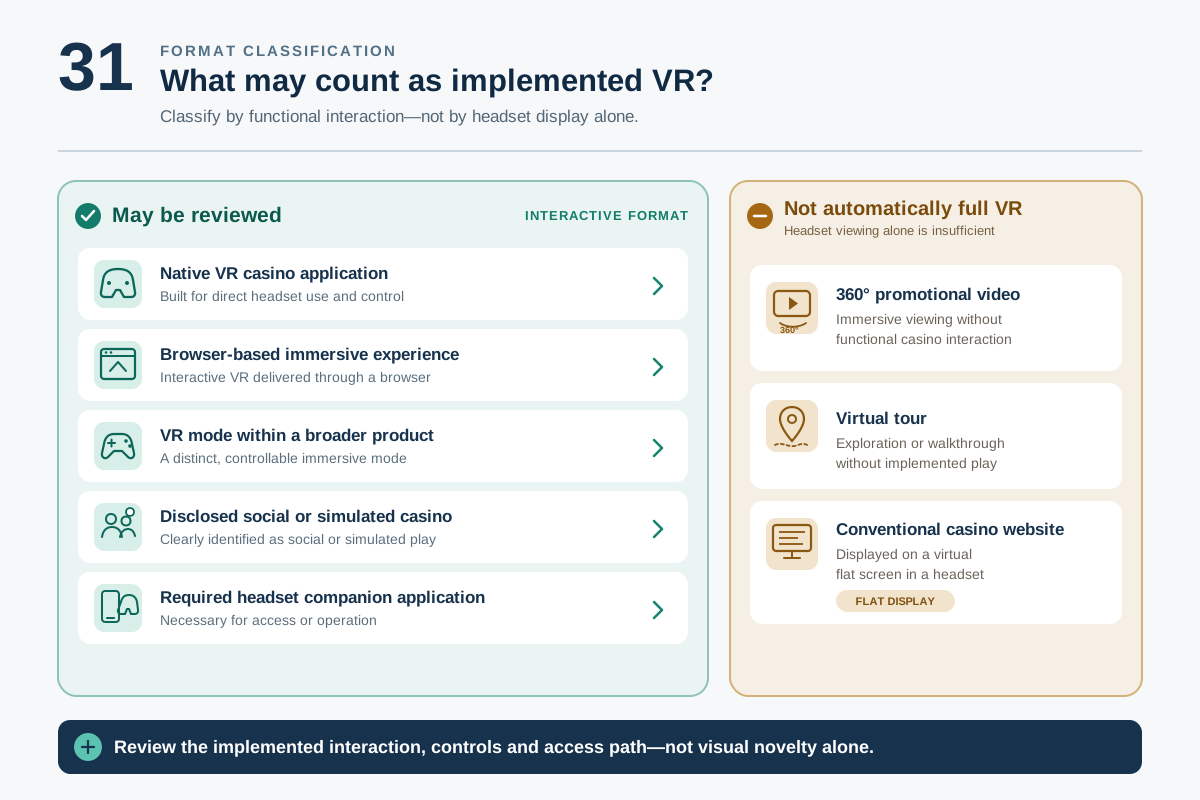
A review may cover:
- A native VR casino application
- A browser-based immersive casino experience
- A VR mode within a broader gambling product
- A social or simulated casino application with clear disclosure that it does not offer real-money gambling
- A companion application needed to access casino features in a headset
We distinguish these formats because they create materially different experiences. A 360-degree promotional video, virtual tour, or conventional casino website displayed inside a headset does not automatically qualify as a fully implemented VR casino.
Rating eligibility
A product must have enough verifiable information to support a meaningful evaluation. We may withhold an overall score when:
- The product cannot be accessed and has insufficient official documentation
- Its identity or ownership is unclear
- Licensing claims cannot be matched to an identifiable legal entity
- Device compatibility claims are materially contradictory
- Regional availability cannot be determined
- A critical claim depends entirely on unattributed promotional material
Withholding a score is not the same as assigning a low score. It means the available evidence is insufficient for a defensible rating.
VR Support, Device Compatibility, and Game Checks
Product verification begins with the VR experience itself. We look beyond labels such as “metaverse,” “3D,” and “immersive” to determine what users can actually do.
VR implementation
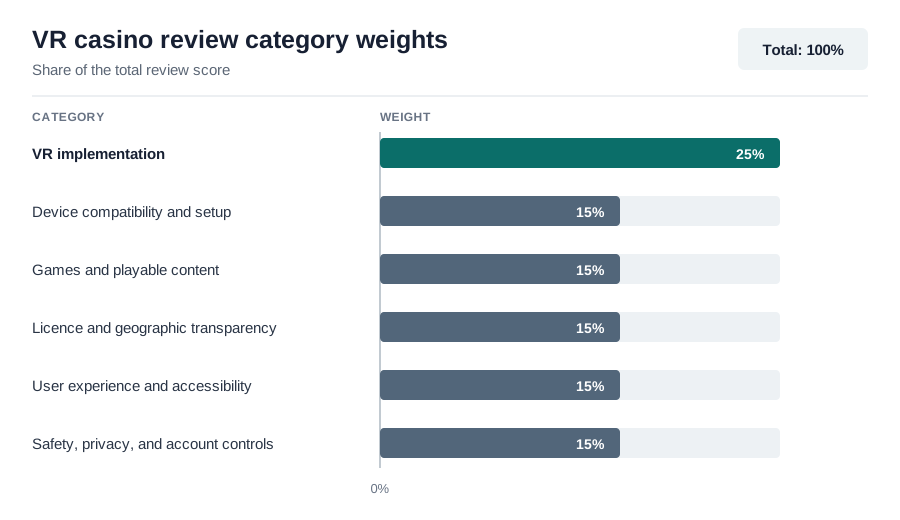
The VR implementation category carries 25% of the total score. Checks may include:
- Whether the product provides a native or purpose-built VR interface
- Head tracking and the consistency of viewpoint movement
- Support for motion controllers, hand tracking, gaze input, or standard controllers
- Interaction with tables, menus, chips, cards, machines, or other objects
- Locomotion and navigation options
- Readability of menus, balances, rules, and account information
- Stability during launch, login, gameplay, and scene transitions
- Whether users are unexpectedly redirected to flat-screen interfaces
- Comfort options such as seated play, recentering, turning methods, or movement settings
- Alignment between advertised VR features and the accessible product
We do not treat visual novelty as a substitute for functional implementation. A visually elaborate lobby may score poorly if core tasks require users to leave VR or interact through an unsuitable interface.
Performance observations are tied to the tested setup. They are not presented as universal results for every headset, computer, connection, or account.
Supported devices and setup
Device support carries 15% of the total score. We document compatibility as precisely as the evidence permits, including:
- Named headset models or product families
- Standalone, PC-connected, console, or mobile operation
- Required operating system or software platform
- App-store or direct-install availability
- Wired, wireless, or streaming requirements
- Supported controller types
- Account, companion-app, or browser requirements
- Geographic restrictions affecting installation or access
- Whether a previously supported device appears to have been discontinued
“VR compatible” is not sufficiently precise on its own. Compatibility must be linked to identifiable hardware and a usable access method.
When we test only one configuration, we label that result as self-tested for that configuration. Support for other devices remains officially documented or unverified, depending on the available evidence.
Games and playable content
Game and content quality carries 15% of the total score. We consider:
- Which games are actually playable in VR
- Whether the VR library differs from the operator’s standard catalog
- The availability of table games, slots, live games, or social experiences
- Whether gameplay uses VR controls or relies on a flat virtual screen
- Clarity of rules, stakes, balances, and outcomes
- Loading behavior and transitions between the lobby and games
- Consistency of interaction across different titles
- Whether multiplayer or social features work as described
- Whether game-provider and certification claims are attributable
A large conventional game catalog does not receive full credit if only a small or unclear portion works in VR. Conversely, a smaller catalog can perform well when its available games are properly adapted and clearly documented.
We do not independently certify random number generators, game fairness, or payout calculations unless an expressly identified technical audit is available. Regulatory, testing-laboratory, or game-provider claims must be attributed to their source rather than presented as our own verification.
Licence, Geography, User Experience, and Safety Criteria
Licence status and regional restrictions
Licensing and geographic transparency account for 15% of the score. The review records, where available:
- The legal entity operating the service
- The stated licensing authority
- The licence number or other identifying reference
- Whether the licence details can be matched to an official register
- Countries or territories the service says it accepts
- Excluded or restricted regions
- Age requirements
- Identity-verification requirements
- Differences between app availability and real-money eligibility
A licence logo or unsupported statement is not treated as proof. We look for a traceable connection between the brand, operating entity, domain or application, and the relevant regulatory record.
Licence verification does not mean that the service is legal for every reader. Gambling laws, local restrictions, and an individual’s eligibility can differ by jurisdiction. Users remain responsible for checking the rules that apply where they are located.
Serious uncertainty in this category can override the numerical result. A polished VR experience does not compensate for an untraceable operator identity or a materially unverifiable licensing claim.
User experience and accessibility
User experience carries 15% of the score. It covers the complete path from discovery to regular use, not only the visual quality of the virtual environment.
We assess:
- Installation and first-time setup
- Account creation and headset login
- Menu structure and navigation
- Text size, contrast, and readability
- Balance, bet, and session information
- Deposits and withdrawals where applicable
- Error messages and recovery options
- Customer-support access
- Session exit and logout controls
- Seated-use and comfort options
- Accessibility information supplied by the operator
- Clarity when moving between VR and non-VR account functions
We avoid claiming that a product is universally accessible. Accessibility needs vary, and a feature that helps one user may not address another user’s requirements. Reviews describe observed controls and documented options instead.
Safety, privacy, and account controls
Safety-related checks carry 15% of the score. This category considers visible and documented safeguards, including:
- Secure connection availability for web-based account pages
- Privacy-policy accessibility
- Explanations of data collection and permissions
- Account authentication options
- Payment and withdrawal information
- Session, deposit, loss, or spending controls where offered
- Self-exclusion and account-closure information
- Access to gambling-support resources
- Clear separation of real-money and simulated play
- Permission requests for microphones, cameras, movement data, or social features
- Reporting, blocking, or moderation tools in multiplayer environments
These checks are not a penetration test, privacy audit, or guarantee against data loss. Unless specifically documented, we do not claim to have inspected source code, internal systems, payment infrastructure, or security architecture.
Evidence Labels and Scoring
Evidence labels
Each significant statement should be traceable to its evidence level.
| Evidence label | Meaning | Appropriate use | Limitation |
|---|---|---|---|
| Self-tested | Directly observed during a recorded review check | Installation, device behavior, interface, controls, visible game access, and tested account flows | Applies only to the tested date, device, region, and configuration |
| Officially documented | Stated by an identifiable primary source | Device lists, licence records, app-store availability, operator terms, game-provider information, and regional policies | Documentation may be outdated or may not match every user’s experience |
| Unverified | Not confirmed through direct testing or reliable primary documentation | Inaccessible features, unsupported marketing claims, user-reported behavior, or unclear compatibility | Does not earn the same scoring credit as verified evidence |
A single review can use all three labels. For example, an application may be self-tested on one headset, officially documented for two additional devices, and unverified for a discontinued platform mentioned only in older promotional material.
Attribution rules
Information is attributed as closely as possible to its origin:
- Regulatory status is tied to the relevant regulator or public register.
- Device compatibility is tied to testing, an app-store listing, or official product documentation.
- Game availability is tied to the accessible library or an identifiable provider catalog.
- Regional restrictions are tied to published terms, registration controls, or official support information.
- Performance observations identify the tested environment rather than implying universal results.
Affiliate tracking, referral arrangements, advertising, or other commercial considerations are not evidence of product quality. They do not affect category scores or evidence labels. For broader publication standards, see the editorial policy.
The scoring scale
Each category receives a raw score from 0 to 5.
| Raw score | Interpretation | General standard |
|---|---|---|
| 0 | Absent or critically deficient | The feature is unavailable, unusable, or unsupported by credible evidence |
| 1 | Poor | Major problems substantially limit normal use |
| 2 | Below average | Basic functionality exists, but important limitations remain |
| 3 | Adequate | Core requirements are met with some notable weaknesses |
| 4 | Strong | Reliable implementation with only limited shortcomings |
| 5 | Excellent | Comprehensive, usable, and well-supported implementation for the category |
The raw score is converted according to the category weight:
Weighted category score = category weight × (raw score ÷ 5)
The weighted category scores are then added to produce a result out of 100.
| Evaluation category | Weight |
|---|---|
| VR implementation | 25% |
| Device compatibility and setup | 15% |
| Games and playable content | 15% |
| Licence and geographic transparency | 15% |
| User experience and accessibility | 15% |
| Safety, privacy, and account controls | 15% |
| Total | 100% |
The numerical result summarizes the evaluation; it does not cancel critical warnings. Material licensing uncertainty, inaccessible terms, misleading compatibility claims, or other serious concerns are displayed separately and may result in the rating being withheld.
Review Process, Updates, and Example Evaluation
Review procedure
We apply the framework in the following order:
- Identify the product and operator. We record the brand, application, domain, operating entity, and stated product type.
- Collect primary documentation. We check official product pages, app-store listings, terms, compatibility information, and regulatory records where available.
- Define the test setup. The device, platform, region, access method, and test date are recorded.
- Check the VR experience. We examine installation, launch, controls, navigation, comfort, stability, and transitions.
- Inspect playable content. We determine which games or features operate in VR and which require a conventional interface.
- Review legal and regional information. We compare operator claims with identifiable licence information and published restrictions.
- Assess UX and safety signals. We check account flows, disclosures, permissions, support access, and user controls.
- Assign evidence labels. Each material finding is marked as self-tested, officially documented, or unverified.
- Calculate category scores. Raw scores are converted using the published weights.
- Record limitations and conflicts. Contradictory, inaccessible, or time-sensitive information is disclosed rather than silently resolved.
How reviews are updated
VR applications can change after operating-system updates, headset releases, store-policy changes, licensing changes, or product redesigns. Reviews are therefore reassessed when a material change becomes known.
Update triggers include:
- A new or discontinued headset
- A major application or interface release
- A change in installation method
- Significant additions or removals from the VR game library
- A licence, ownership, or domain change
- New country restrictions
- Changes to account, payment, privacy, or safety controls
- Credible evidence that a previously reported feature no longer works
The review should show when its key checks were completed. Older self-tested findings are not automatically presented as current when the underlying product has materially changed.
Example evaluation table
The following example demonstrates the calculation only. It does not represent an actual operator or application.
| Category | Weight | Raw score | Weighted score | Primary evidence | Example note |
|---|---|---|---|---|---|
| VR implementation | 25 | 4 | 20 | Self-tested | Functional immersive interface with minor transition issues |
| Device compatibility | 15 | 3 | 9 | Tested and documented | One configuration tested; additional devices officially listed |
| Games and content | 15 | 4 | 12 | Self-tested | Clear VR library with consistent controls |
| Licence and geography | 15 | 5 | 15 | Officially documented | Entity and licence details matched to a primary record |
| User experience | 15 | 3 | 9 | Self-tested | Core tasks work, but some account functions leave VR |
| Safety and account controls | 15 | 4 | 12 | Tested and documented | Key policies and controls are accessible |
| Total | 100 | 77/100 | Subject to any separate critical warnings |
This methodology explains how evidence becomes a score. It does not publish or replace the actual operator comparisons on the best VR casinos page. More information about the project is available on the About page.