A VR casino is not regulated simply because it uses virtual reality. Licensing usually follows the underlying activity: who operates the games, whether players provide something of value, whether prizes can be redeemed for value, where the operator is established, and where players are located.
A real-money casino delivered through a VR headset will generally be assessed under the same gambling framework as an online casino offering comparable games through a website or mobile app. A purely social VR casino may fall outside gambling licensing in some jurisdictions, but labels such as “social,” “free,” or “sweepstakes” do not determine legal status on their own.
The practical questions are:
- Does the activity meet the relevant legal definition of gambling?
- Which company is legally responsible for operating it?
- What games, services, and transaction flows does that company control?
- Where is the operator established or licensed?
- In which countries or states are players accepted?
- Does the authorization cover remote casino activity and the specific product offered?
- Are separate approvals required for software, game suppliers, payments, or other participants?
Because these answers vary by jurisdiction, no single VR casino license provides automatic worldwide legality.
How Licensing Applies to VR Casinos
VR is normally a delivery interface, not a separate category of gambling license. Regulators are more likely to examine the economic and operational substance of a product than whether it appears on a flat screen, inside a three-dimensional lobby, or through an immersive headset.
If an operator accepts wagers and awards cash or cash-equivalent prizes, adding avatars, spatial audio, motion controls, or virtual casino rooms does not ordinarily turn the activity into unregulated entertainment. Conversely, a multiplayer VR environment containing casino-style graphics is not necessarily regulated gambling if it lacks the elements required by the applicable law.
The operator matters more than the interface
The regulated operator is usually the legal entity that offers or controls the gambling activity. Depending on the business model, that entity may:
- contract directly with players;
- operate player accounts and wallets;
- set or publish game rules;
- accept stakes or other consideration;
- determine or distribute prizes;
- control access by country, state, or territory;
- conduct identity, age, and anti-money-laundering checks;
- hold customer funds;
- manage complaints and responsible-gambling controls.
A VR platform, headset manufacturer, app marketplace, software studio, payment provider, game supplier, or hosting company may be a separate participant. Some jurisdictions license or approve certain suppliers as well as the consumer-facing operator. In others, suppliers may be subject to registration, certification, contractual controls, or suitability reviews rather than the same license held by the casino.
The parties’ own description of the arrangement is not conclusive. A company presented as a “technology provider” may attract greater regulatory scrutiny if it actually controls player funds, game outcomes, customer relationships, or essential gambling operations.
Common legal elements
Many legal systems assess gambling by asking whether an activity includes some combination of:
- Consideration: the player pays money, transfers something valuable, or makes a qualifying purchase to participate.
- Chance: the outcome is wholly or partly determined by randomness rather than skill alone.
- Prize: the player can receive money, property, redeemable credits, transferable assets, or another item recognized as valuable.
The terminology and legal tests are not universal. Some jurisdictions regulate particular games even when one element appears absent. Others distinguish gaming, betting, lotteries, prize competitions, and promotional draws. The treatment of virtual items, tokens, digital assets, secondary markets, and indirect purchases can also differ.
For that reason, removing a cash withdrawal button does not necessarily resolve the licensing question. Regulators may consider how value enters the product, how rewards are used, whether they can be transferred, and whether an associated marketplace gives them practical monetary value.
What a gambling license usually authorizes
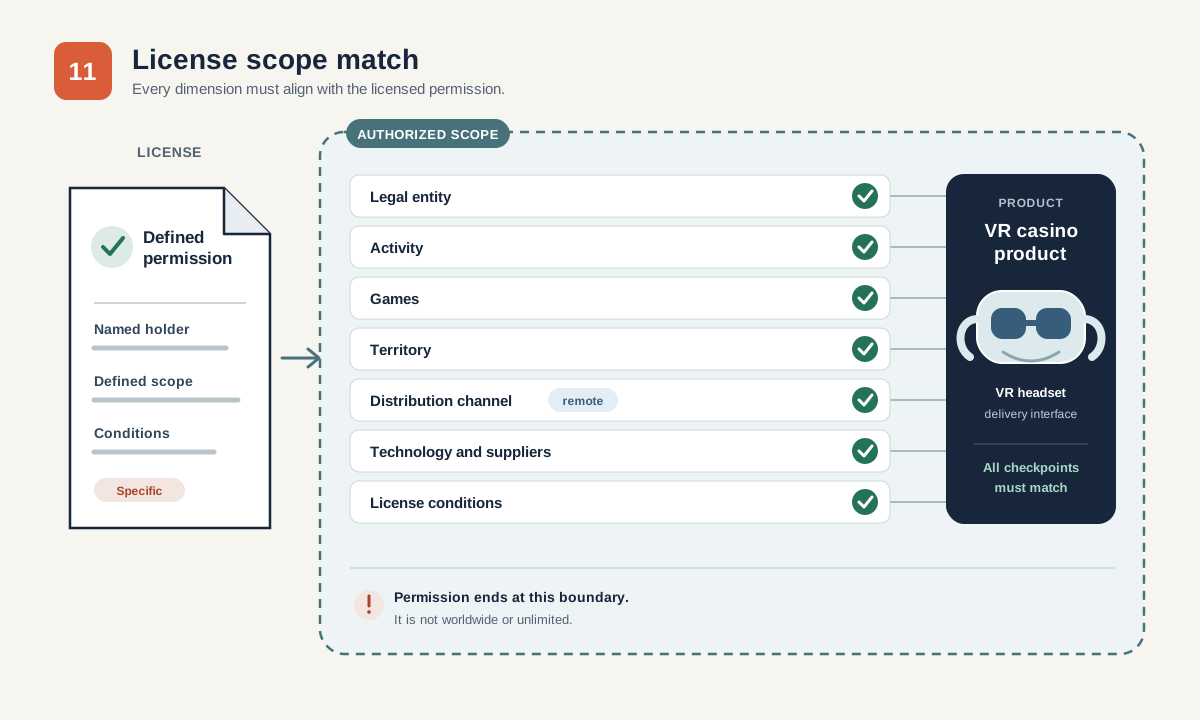
A license is permission granted to a named legal entity for specified activities under specified conditions. It is not a general certificate that makes every product or market lawful.
The scope may be limited by:
| Licensing dimension | What must be matched to the VR casino |
|---|---|
| Legal entity | The company named on the license should correspond to the company offering the service |
| Activity | The authorization should cover the relevant form of remote casino gaming, betting, or other regulated activity |
| Games | Some permissions or approvals apply only to particular game categories |
| Territory | The license may authorize operations from or into defined jurisdictions rather than globally |
| Distribution channel | Remote or online permission may be required even if the same group operates physical venues |
| Technology and suppliers | Games, platforms, testing laboratories, or critical suppliers may need approval or certification |
| License conditions | The operator must comply with restrictions concerning players, payments, marketing, reporting, and controls |
A license number displayed in a VR lobby therefore answers only part of the question. The number must relate to the correct company, activity, domain or product where applicable, and target market.
Real-Money, Play-Money, Social, and Sweepstakes Models
Product classification is central to licensing, but marketing terms are not legal conclusions. Two VR casino products with similar roulette tables and slot-machine graphics can have different legal status because their payment and reward structures differ.
Real-money VR casinos
A real-money VR casino allows players to risk money or another recognized form of value for a chance to receive money or valuable prizes. This is the model most likely to require a remote gambling license where it is offered.
Regulators may expect controls covering areas such as:
- minimum-age enforcement;
- customer identity verification;
- anti-money-laundering procedures;
- sanctions and risk screening where applicable;
- segregation or protection of player funds;
- game testing and technical standards;
- fair and accurate game rules;
- responsible-gambling tools;
- complaint handling;
- security and incident reporting;
- marketing and bonus conditions;
- geographic access controls;
- regulatory reporting and auditing.
The exact obligations depend on the licensing jurisdiction and the markets served. A regulator may also impose conditions on live dealers, peer-to-peer interaction, payment methods, outsourcing, or the use of third-party games.
Play-money and social VR casinos
A play-money product typically uses virtual credits and does not offer direct cash redemption. Such products are often called social casinos, particularly when they emphasize entertainment, multiplayer interaction, progression, collections, or virtual environments.
A social label does not create a blanket exemption. Relevant questions can include:
- Are credits free, purchased, or obtained through both methods?
- Must users make a purchase to access meaningful play or promotional entry?
- Can credits, rewards, or virtual items be sold or transferred?
- Is there an official or tolerated secondary market?
- Can rewards be exchanged for goods, services, digital assets, or other benefits?
- Do purchases influence eligibility for prizes?
- Is the product available to minors?
- Are paid random-reward mechanics regulated separately?
- Do consumer-protection or platform rules apply even if gambling licensing does not?
A product may fall outside the local definition of gambling and still be subject to rules on consumer protection, advertising, privacy, age-appropriate design, digital purchases, or unfair commercial practices.
For a user-focused explanation of the practical distinction, see real-money and play-money VR casinos. That distinction should be considered separately from the formal legal analysis required in each market.
Sweepstakes and promotional models
Sweepstakes-based products often use alternative entry methods or multiple forms of virtual currency. Their operators may argue that the structure removes legally required consideration or otherwise falls within promotional-prize rules.
The legality of this model is highly dependent on local law and its actual operation. Authorities may examine:
- whether a free entry route is genuine and reasonably accessible;
- whether purchases provide entries or materially affect participation;
- whether the prize has monetary value;
- whether the game is based on chance;
- how the product is promoted to consumers;
- whether state, provincial, or national prohibitions apply;
- whether registration, bonding, disclosures, or official rules are required.
Calling a product a sweepstakes, promotional game, or social casino does not settle its classification. Operators also cannot assume that a structure accepted in one country or state will be accepted in another.
Virtual currencies and digital assets
VR products may use coins, chips, tokens, skins, non-fungible tokens, or other digital items. Their names are less important than their function.
Regulatory risk can increase when an asset is:
- purchasable with money;
- redeemable by the operator;
- transferable between users;
- tradeable on an external market;
- convertible into cryptocurrency or other assets;
- usable to enter games with valuable prizes;
- promoted as having lasting or investment value.
The absence of direct operator redemption may not be decisive if a functioning secondary market gives the asset practical value. The legal treatment of digital assets remains jurisdiction-specific and may involve financial, payments, securities, or consumer-protection rules in addition to gambling law.
Regulators, Permissions, and Geography
There is no global VR casino regulator. Authority may sit with a national gambling commission, a state or provincial agency, a territory-level authority, or several bodies with overlapping responsibilities.
Home jurisdiction and player location
Two geographic questions should be considered separately:
- Where is the operator established and regulated?
- Where is each player physically located when using the service?
An operator may hold a license in its home jurisdiction but still be prohibited from accepting players in another market. Some countries recognize or permit services from approved overseas operators, while others require a local license, local entity, local technical setup, or specific market authorization. Some prohibit online casino gaming entirely or allow only designated operators.
Player nationality is not always the controlling factor. Regulators may focus on physical location, residence, payment source, marketing activity, or a combination of these factors.
VR can complicate location assessment because a user’s account profile, device settings, network connection, billing information, and physical location may not align. Operators commonly use multiple controls rather than relying only on a user-selected country.
National and subnational regulation
A national license may cover an entire country in one market but have limited relevance in another. In federal systems, gambling authority may be divided among states, provinces, tribal authorities, and federal bodies.
This can produce several outcomes:
- online casino gaming is legal only in selected states or provinces;
- different regulators oversee casino games, sports betting, and lotteries;
- local market access is required in addition to an overseas license;
- tribal gaming arrangements affect where and by whom games may be offered;
- advertising is restricted even when the underlying service is licensed elsewhere.
A statement that a VR casino is “licensed internationally” is therefore insufficient. The key issue is whether it is authorized to serve the player’s location.
Common types of permission
Terminology differs, but a regulatory framework may distinguish between:
- Business-to-consumer authorization: permission to offer gambling directly to players.
- Business-to-business authorization: permission to supply games, platforms, or other gambling technology.
- Game or technical approval: acceptance or certification of a particular game, random number generator, platform, or system.
- Key-person approval: suitability review of owners, directors, senior managers, or specified staff.
- Premises authorization: permission connected to a physical casino, studio, or operational site.
- Local market approval: permission to serve players in a particular country, state, or province.
A software supplier’s approval does not automatically authorize a consumer-facing casino. Similarly, a land-based casino license may not include remote gambling. The precise categories must be read in the context of the issuing authority’s rules.
What regulators commonly assess
Although standards vary, licensing reviews frequently consider:
- ownership and corporate structure;
- source of funds and financial stability;
- suitability of controllers and key personnel;
- technical security and system integrity;
- fairness and testing of games;
- anti-money-laundering controls;
- player-fund arrangements;
- identity and age controls;
- responsible-gambling measures;
- complaint and dispute processes;
- outsourcing and supplier oversight;
- data retention and regulatory access;
- advertising and promotional conduct;
- plans for restricted or excluded territories.
Licensing is an ongoing relationship, not merely an initial application. Authorized operators may be subject to audits, reporting obligations, technical change controls, compliance assessments, enforcement action, and renewal requirements.
Official Registers and Jurisdiction Guides
An operator’s own licensing statement should be compared with information published by the relevant regulator. Official records may identify the licensed legal entity, account or license number, current status, approved activities, trading names, and associated websites.
Useful official resources include:
- Great Britain: the UK Gambling Commission Public Register provides records for licensed businesses and individuals.
- Malta: the Malta Gaming Authority Licensee Register provides information about MGA-authorized entities and services.
Register layouts and URLs can change. When in doubt, begin at the regulator’s official government or authority website rather than relying on a badge, search advertisement, affiliate page, or screenshot supplied by the casino.
This page does not provide a complete verification procedure. For the specific checks to perform and the warning signs to recognize, use the guide to checking a casino license.
Jurisdiction-specific guidance
Licensing systems should not be treated as interchangeable. The following guides explain the relevant authorities and framework at a jurisdiction level:
- United Kingdom VR casino licensing guide
- Malta VR casino licensing guide
- Curaçao VR casino licensing guide
These guides should be used alongside the regulator’s current publications. Laws, license categories, transitional arrangements, and public-register formats can change.
Information worth recording
Without attempting a full audit, a reader assessing a licensing claim should be able to identify:
- the operator’s full legal name;
- the regulator’s name;
- the license, account, or authorization number;
- the current status shown by the authority;
- the regulated activities or permissions;
- any listed trading names, domains, or brands;
- restrictions relevant to the player’s location;
- the company named in the casino’s terms and privacy information.
A mismatch does not always prove illegality; corporate groups can contain several licensed and unlicensed service companies. It does, however, justify closer examination. The entity contracting with the player should have a clear relationship to the authorization being claimed.
Common licensing mistakes
Users and publishers frequently make the following errors:
- Treating a logo as proof. A regulator’s badge can be copied or linked to an unrelated record.
- Checking only that a license exists. The permission may belong to another company or cover a different activity.
- Assuming one license covers every country. Market access depends on the laws of the player’s location.
- Confusing a supplier with the operator. Approved game software does not make every casino using it licensed.
- Equating company registration with gambling authorization. Incorporation records and general business licenses are not gambling licenses.
- Assuming play-money means unregulated. The payment, prize, transfer, and redemption structure still matters.
- Ignoring current status. A license may be suspended, surrendered, expired, limited, or subject to conditions.
- Relying on app-store availability. Distribution through a headset or mobile marketplace is not evidence of gambling authorization.
VR Casino Licensing FAQ
Does a VR casino need a special virtual-reality gambling license?
Usually, VR itself does not create a separate licensing category. The operator generally needs authorization for the underlying gambling activity, such as remote casino gaming. Technical systems, games, suppliers, or distribution arrangements may require additional approval depending on the jurisdiction.
Is a VR casino legal if it does not accept cash directly?
Not necessarily. Authorities may consider purchases of virtual credits, redeemable prizes, transferable assets, cryptocurrency, indirect payments, and secondary markets. A no-cash label is not enough to determine legal status.
Are social VR casinos legal everywhere?
No. A social casino may fall outside gambling licensing in one jurisdiction but face gambling, prize-promotion, consumer-protection, age, advertising, or digital-purchase restrictions in another. Its actual payment and reward mechanics matter more than its label.
Does an overseas gambling license allow a casino to accept players worldwide?
No. A license normally operates within a defined legal framework and does not override the laws of every player location. Another country or state may require local authorization, restrict particular games, or prohibit online casino activity.
Is an app-store listing evidence that a VR casino is licensed?
No. Marketplace availability shows that an app was distributed through that platform at a particular time. It does not establish that the operator has the gambling permissions required in every territory where the app can be downloaded.
Can the headset manufacturer or VR platform be the regulated operator?
It can be, but only if that company actually performs the regulated role and holds the appropriate authorization. More commonly, the platform and casino operator are separate entities. The terms of service should identify the company responsible for the gambling activity.
Which regulator should a player check?
Start with the regulator named by the operator, then determine whether that authority’s license is relevant to the player’s location and the activity offered. Where local licensing is required, consult the regulator for the country, state, province, or territory in which the player is located.
What if a license record and the casino’s legal information do not match?
Do not assume the authorization covers the casino. Differences in company name, domain, trading name, status, or permitted activity require clarification through the official register and the operator’s legal documents. Use the dedicated license verification guide for a more systematic review.
Licensing conclusions should always be tied to a specific operator, product, and target geography. For legal or compliance decisions, current advice from a qualified professional in the relevant jurisdiction may be necessary.