Curaçao’s current gambling regulator is the Curaçao Gaming Authority (CGA). Under the jurisdiction’s reformed framework, online gambling businesses are expected to obtain authorization directly from the CGA rather than operate through the former master-licence and sublicence structure.
A Curaçao licence claim should be verified against an official CGA record. The check must confirm the licensed legal entity, the relevant domain or platform, the permitted activity, the licence status, and any conditions or expiry information. A badge or seal displayed by the operator is not sufficient evidence on its own.
Because Curaçao has moved from its previous system into a new regulatory framework, operators may refer to direct licences, transitional rights, pending applications, older sublicences, or provisional status. These terms are not interchangeable. Record the date of every verification and use the regulator’s current register or certificate-validation service to determine what authorization is actually in force.
Curaçao Regulator and Current Framework
The Curaçao Gaming Authority is responsible for regulating games of chance in Curaçao. It took over the role previously associated with the Curaçao Gaming Control Board as part of the jurisdiction’s regulatory reform.
The present framework is based on Curaçao’s National Ordinance on Games of Chance, commonly referred to by the Dutch abbreviation LOK. It replaced the long-standing offshore structure under which a small number of master-license holders issued sublicences to online operators.
The central change is direct regulatory oversight. Instead of relying on a contractual relationship with a master-license holder, an operator applying under the current system deals with the CGA itself.
What the CGA framework is intended to regulate
The framework covers matters such as:
- authorization of online gambling operators;
- licensing or approval of relevant gambling suppliers;
- identification of the legal entity responsible for an operation;
- suitability of owners, directors and other relevant persons;
- approved websites, domains and gambling activities;
- technical and operational compliance;
- anti-money-laundering and counter-terrorist-financing controls;
- player-fund and responsible-gambling requirements;
- ongoing reporting, supervision and enforcement.
The existence of a licence does not mean that every website connected to the licensee is automatically covered. Regulatory status must be assessed at the level of the licensed entity, approved activity and named digital channel.
Former and current Curaçao models compared
| Regulatory feature | Former structure | Current CGA framework |
|---|---|---|
| Primary authorization model | Master licences and privately issued sublicences | Direct authorization by the Curaçao Gaming Authority |
| Operator’s regulatory relationship | Often mediated through a master-license holder | Direct relationship with the CGA |
| Evidence commonly presented | Sublicence certificate or validator linked to a master license | CGA register entry or authority-hosted certificate record |
| Domain coverage | Depended on sublicensing documentation and associated records | Must be checked against the CGA’s approved or recorded details |
| Regulatory terminology | Master license, sublicense and license validator | CGA licence, application, transitional status and official certificate |
| Verification concern | Whether the sublicense was valid and covered the site | Whether the entity, domain and activity have current CGA authorization |
References to the old system may still appear in website footers, legal pages and archived certificates. Their presence does not establish current authorization under the reformed framework.
For an overview of how Curaçao fits into the wider subject, see the online gambling licensing guide.
Licence Types and Transitional Rules
The current Curaçao system distinguishes between businesses that provide gambling to customers and businesses that supply relevant services to the gambling industry.
B2C operator licences
A business-to-consumer, or B2C, licence is intended for an operator that offers gambling directly to players. This generally concerns the legal entity responsible for the customer relationship, including account registration, acceptance of wagers, game access, payments and player terms.
A B2C check should answer four questions:
- Which legal entity holds the licence?
- Which gambling activities may that entity provide?
- Which websites, domains or other channels are covered?
- Is the authorization active and unrestricted for the service being reviewed?
A licence held by one company should not be attributed automatically to an affiliated company, brand owner, payment company or software business. Corporate-group membership is not the same as regulatory authorization.
B2B supplier licences
A business-to-business, or B2B, authorization concerns suppliers serving gambling operators rather than contracting directly with players. Depending on the service and the current CGA rules, this can be relevant to game developers, platform providers, aggregators and other businesses whose technology is integral to gambling operations.
The presence of a licensed supplier does not license the consumer-facing casino. Conversely, an operator licence does not necessarily prove that every supplier used by the operator has completed any authorization required for its own activities.
When reviewing a B2B claim, identify:
- the supplier’s exact legal name;
- the regulated service it provides;
- the operator or platform using that service;
- whether the supplier’s status is active;
- whether the record covers the product involved.
What transitional status means
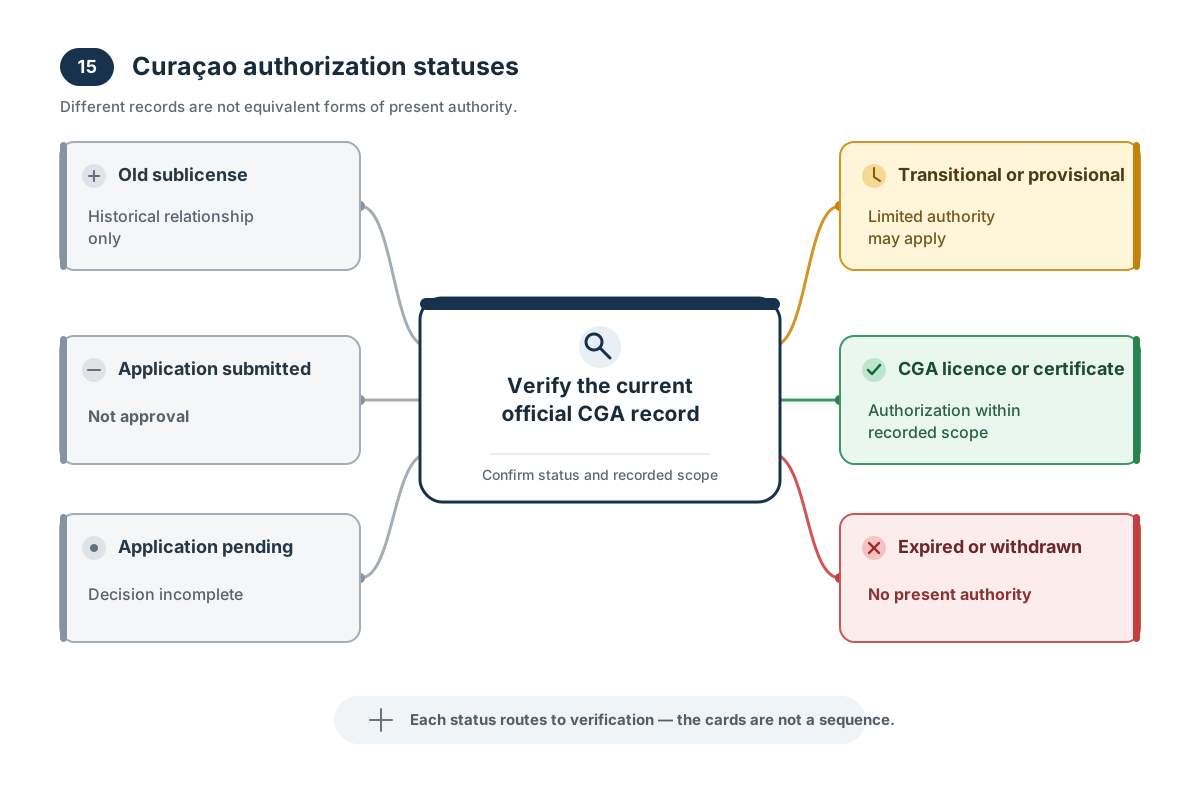
Curaçao’s move from sublicensing to direct regulation created a transition period. Businesses associated with the previous framework could be required to file an application, obtain temporary or transitional recognition, submit further information, or move to a full licence under the new rules.
The resulting terminology can be confusing:
| Status or document | What it may indicate | What it does not prove by itself |
|---|---|---|
| Old sublicense | A relationship under the former master-licence system | Current CGA authorization |
| Application submitted | The operator entered an application process | Approval or permission to operate |
| Application pending | The CGA has not completed its decision | An active full licence |
| Transitional or provisional status | Limited authority may continue under specified conditions | Permanent, unconditional approval |
| CGA licence or certificate | The regulator has granted the recorded authorization | Coverage of an unlisted entity, domain or activity |
| Expired or withdrawn record | Authorization existed previously | Present authority to offer gambling |
Transition deadlines and procedural requirements can change through legislation, regulatory notices or individual decisions. For that reason, an undated article, copied certificate or operator statement should not be treated as the final source of status.
Licence scope matters as much as licence existence
A valid authorization can still be irrelevant to a particular site. Scope may be limited by:
- the named licensee;
- approved brands or trading names;
- listed domains;
- permitted games or gambling categories;
- regulatory conditions;
- effective and expiry dates;
- territorial restrictions;
- suspension, surrender or enforcement action.
The correct question is not simply, “Does this group have a Curaçao licence?” It is, “Does the current CGA record authorize this legal entity to provide this activity through this domain or platform?”
How to Verify a Curaçao Operator and Domain
Use the CGA’s official website as the starting point. Follow its navigation to the current public register, certificate-validation tool or operator record. Search-engine results and third-party licence databases can help locate information, but they should not replace the authority’s own record.
Step-by-step verification process
-
Identify the customer-facing domain.
Record the complete hostname used to register or sign in. A brand may operate several country, product or mirror domains, and only some may appear in the regulatory record. -
Find the operator’s legal name.
Check the terms and conditions, account agreement, privacy notice and payment terms. Record the company name exactly, including its legal suffix and stated registration details. -
Open the CGA’s official register or validator independently.
Navigate from the authority’s official website rather than trusting a badge link supplied by the operator. This reduces the risk of being sent to a copied or lookalike validation page. -
Search for the legal entity.
Compare spelling, corporate form and any identification number shown. A similar brand name or related company is not an exact match. -
Confirm the licence status.
Determine whether the record says active, transitional, suspended, expired, withdrawn, pending or another defined status. Do not interpret “application received” as “licence granted.” -
Match the domain or digital channel.
Confirm that the site being reviewed is included in the official record. Check spelling carefully. Additional words, hyphens and alternative top-level domains can indicate a different website. -
Check the permitted activity and conditions.
Make sure the authorization covers the gambling service offered. Review any public limitations, dates or special conditions. -
Test any digital certificate correctly.
If the operator displays a CGA seal, it should lead to an authority-controlled record for that operator or domain. Confirm the destination’s domain before relying on the information presented. -
Compare the record with the operator’s legal documents.
The licensee named by the CGA should correspond to the company identified as the gambling counterparty in the site’s terms. Investigate unexplained differences. -
Document the check.
Record the date, domain, legal entity, licence number or record identifier, stated status and source consulted. Regulatory records can change, so the verification date is essential.
A reusable method for this process is available in how to check an online gambling licence.
Verification record template
| Field | Information to record |
|---|---|
| Verification date | Date and, where relevant, time of review |
| Brand | Customer-facing trading name |
| Domain or platform | Exact hostname, app identifier or access channel |
| Legal operator | Full company name from contractual documents |
| CGA record | Licence number, certificate number or registry identifier |
| Status | Active, transitional, pending, suspended, expired or other stated status |
| Authorized activity | Gambling activity described in the record |
| Domain match | Exact match, no match or unclear |
| Conditions | Public restrictions, dates or qualifications |
| Evidence source | Official CGA register or authority-hosted certificate page |
| Follow-up required | Any inconsistency that remains unresolved |
If the public record does not provide enough information to establish scope, the appropriate conclusion is unverified, not automatically licensed or unlicensed. The operator or regulator may need to clarify the discrepancy.
How Curaçao Rules Apply to VR Casino Operators
A casino does not fall outside gambling regulation merely because customers access it through a virtual-reality headset, immersive application or three-dimensional environment. The key issue is the underlying regulated activity: offering games of chance to customers.
A VR casino may involve several distinct components:
- a consumer-facing gambling operator;
- a VR application or downloadable client;
- a website used for registration and account management;
- gambling servers and account infrastructure;
- game developers or content suppliers;
- a platform provider;
- payment and identity-verification services.
Each component should be mapped to the legal entity responsible for it. The B2C operator remains especially important because it normally contracts with players and provides the gambling service.
VR-specific scope questions
For a Curaçao-licensed VR operation, check:
-
Is the VR product operated by the named licensee?
A technology company may own the virtual environment while a separate company conducts the gambling activity. -
Is the access channel included in the regulatory record?
A listed website does not necessarily establish that a separate app, headset client or platform deployment is covered. -
Where is the player agreement formed?
The legal terms should identify the company that accepts the account and wagers, even if registration occurs outside the VR environment. -
Are third-party games or platforms separately regulated where required?
A supplier’s role should be distinguished from that of the consumer-facing operator. -
Does the approved activity match the VR service?
The regulator’s record should cover the actual gambling offered rather than an unrelated product operated by the same corporate group. -
Are material platform changes reflected in the authorization?
Launching a new app, domain, delivery method or operator entity may require notice, approval or an update to recorded details.
VR licensing responsibility matrix
| VR casino component | Main verification question |
|---|---|
| Player account | Which licensed entity owns and administers it? |
| Wager acceptance | Which entity legally accepts the bet? |
| VR client or app | Is this channel associated with the authorized operation? |
| Registration website | Is the domain recorded or otherwise within scope? |
| Game content | Who supplies it, and does that supplier require authorization? |
| Platform backend | Which entity operates the gambling system? |
| Terms and conditions | Do they name the same operator shown in the CGA record? |
| Branding | Is the brand connected officially to the licensee? |
The technical novelty of VR does not replace entity-and-domain verification. An immersive lobby can obscure the contractual structure, so the legal operator and access channel should be identified before the licence claim is evaluated.
Scope Limits, Regulatory Risks and Warning Signs
A Curaçao licence is evidence of authorization only within its stated scope. It is not a universal permission to operate in every market, through every brand, or on every digital channel.
Important scope limits
Curaçao authorization does not override local restrictions
A CGA licence concerns authorization under Curaçao’s framework. Whether an operator may serve a person in another country depends on the laws and regulatory requirements applicable there. Operators may also impose their own restricted-country rules.
One licensed company does not cover an entire group
Corporate groups often divide intellectual property, payments, technology and gambling operations among several entities. Only the entity and activities covered by the regulatory record should be described as licensed.
A listed brand may use multiple domains
Alternative domains, redirect sites and localized versions require separate attention. A domain that looks similar to an approved site can still fall outside the recorded scope.
Supplier status is not operator status
A B2B supplier may provide compliant technology without being authorized to offer gambling directly to customers. Likewise, the use of a recognized supplier does not establish the operator’s licence.
Curaçao licence warning signs
Treat the following as reasons for further investigation:
- the operator refers only to an old sublicense and gives no current CGA status;
- the site says an application is pending but presents that application as a granted licence;
- the CGA record names a different legal entity from the player terms;
- the reviewed domain does not appear in the official record where domains are listed;
- a seal opens an operator-controlled page instead of an authority-controlled certificate;
- the certificate number cannot be found through the CGA’s official route;
- the record is expired, suspended, withdrawn or otherwise inactive;
- the operator omits the legal company name from contractual documents;
- the brand claims group-wide coverage without identifying the licensed entity;
- the authorization concerns a supplier, but the business presents it as a consumer-facing operator licence;
- the VR app or platform is not clearly connected to the authorized domain and legal operator;
- regulatory wording is undated despite Curaçao’s transition to a new system.
No single discrepancy always proves that an operation lacks authorization. It does mean the licence claim should not be accepted until the entity, status and scope have been reconciled through official information.
Curaçao Licence Review Checklist
Before treating a Curaçao casino or VR gambling platform as licensed, confirm all of the following:
- [ ] The regulator is identified as the Curaçao Gaming Authority.
- [ ] The operator’s full legal name is available.
- [ ] The legal name matches the official CGA record.
- [ ] The record reflects a granted or otherwise valid operating status, not merely an application.
- [ ] The exact domain or relevant digital channel is covered.
- [ ] The authorization applies to the gambling activity offered.
- [ ] Any transitional status remains valid under current CGA rules.
- [ ] The licence belongs to the B2C operator rather than only to a supplier or affiliate.
- [ ] The VR app, website and account operator are clearly connected.
- [ ] Public conditions, restrictions and dates have been reviewed.
- [ ] The verification came from an official CGA source.
- [ ] The date and result of the legal-status check were recorded.
Curaçao’s reformed system makes the regulator’s own record the central reference point. The most reliable assessment combines that record with an exact match of the operator, domain, activity and current status—especially where an older sublicense or a new VR delivery channel complicates the picture.