The difference between real-money, play-money, and sweepstakes VR casinos comes down to three questions:
- What are you risking?
- What can you win?
- Can you redeem or withdraw anything of real-world value?
A real-money VR casino accepts monetary wagers and may pay withdrawable winnings. A play-money VR casino uses virtual chips that normally have no cash value, even when more chips can be purchased. A sweepstakes casino may use a separate promotional currency that can potentially be redeemed for prizes if its rules and eligibility requirements are met.
The VR interface does not determine the financial model. A realistic casino floor, multiplayer poker table, or virtual slot machine may still be only a social game. Conversely, a gambling service remains real-money gambling when accessed through a VR headset rather than a conventional screen.
Real Money vs Play Money vs Sweepstakes
The following comparison covers the practical differences users should check before depositing, purchasing virtual currency, or expecting a withdrawal.
| Comparison point | Real-money VR casino | Play-money or social VR casino | Sweepstakes-style casino |
|---|---|---|---|
| What the user plays with | Deposited money or a balance representing real funds | Virtual chips, coins, credits, or tokens | Usually one or more virtual currencies, sometimes including a promotional currency |
| Can users buy currency? | Users generally fund an account to place wagers | Often yes, through optional in-app purchases | Purchasable entertainment currency may be available; promotional currency distribution depends on the operator’s rules |
| Is money at risk during play? | Yes | Purchased virtual currency can be spent, but it is not normally a cash wager or redeemable balance | Promotional play may lead to prize eligibility, although rules and conditions apply |
| Can winnings be withdrawn? | Potentially, subject to verification, balance rules, and withdrawal conditions | Normally no | Eligible promotional winnings may be redeemable for prizes under the published rules |
| Does a larger chip balance equal cash? | A withdrawable account balance may represent money, subject to terms | No; a large virtual-chip balance generally has no monetary value | Only an eligible redeemable balance has potential prize value; other coins may have none |
| Typical purpose | Gambling for monetary outcomes | Entertainment, simulation, practice, and social interaction | Promotional gaming with possible prize redemption |
| Common account controls | Identity, age, location, payment, and withdrawal checks | Platform account, age rating, parental controls, and purchase settings | Age, location, identity, and redemption eligibility checks may apply |
| Main user risk | Losing deposited funds and experiencing gambling-related harm | Overspending on non-redeemable items or misunderstanding virtual value | Confusing currencies, overlooking redemption conditions, or assuming every balance is withdrawable |
| Legal status | Depends on the user’s location and the operator’s authorization | Usually treated differently from gambling when no prize of value is available, but local rules vary | Depends on the promotional structure, official rules, eligibility, and local law |
This table describes common models, not a guarantee about any particular application. The operator’s terms, cashier information, promotional rules, and local availability control what users can actually buy, play with, or redeem.
What Users Pay, Win, and Withdraw
Real-money gambling
In a real-money VR casino, the user places wagers with funds that have monetary value. The headset may provide a three-dimensional interface, but the underlying transaction is similar to gambling through a website or mobile application.
A typical flow is:
- Create an account. The operator may request personal information and confirm the user’s age and location.
- Fund the account. Money is added through an available payment method.
- Place a wager. Part of the cash balance is risked on a game outcome.
- Receive the result. The balance decreases after a loss or increases after an eligible win.
- Request a withdrawal. The operator may require identity, payment, or other account verification before releasing funds.
A displayed balance is not always immediately withdrawable. Pending wagers, unresolved verification, withdrawal limits, bonus conditions, payment-method restrictions, or account reviews can affect access to funds. Users should examine the withdrawal section of the terms before depositing rather than after winning.
Real-money gambling can also involve bonuses or promotional credits. These should not automatically be treated as cash. A promotion may have separate requirements that determine when associated winnings become eligible for withdrawal.
Play-money and social gaming
A play-money VR casino uses virtual currency without normal cash-redemption rights. The user might receive chips when opening an account, earn them through play, collect daily rewards, or purchase additional packages.
The key distinction is simple:
A virtual chip can cost money without being worth money.
For example, a user may pay for a bundle of digital chips to continue playing poker in a social VR room. Those chips can provide entertainment and access to gameplay, but they generally cannot be returned to the operator in exchange for cash. Winning more chips usually increases only the in-game balance.
This model is often called social casino gaming when it reproduces casino-style activities without offering ordinary cash prizes. “Social” does not necessarily mean free. The application may sell currency, cosmetic items, subscriptions, event access, or convenience features.
Readers looking specifically for entertainment-only options can use the separate guide to free VR casino games. The presence of free access, however, should not be confused with an assurance that every optional feature is free.
Sweepstakes-style play
Sweepstakes casinos occupy a different category. They commonly separate entertainment currency from a promotional currency associated with prize redemption.
A simplified structure may include:
- Standard coins or credits: used for entertainment and not redeemable for cash or prizes.
- Promotional or sweepstakes currency: used in eligible promotional play and potentially redeemable after applicable conditions are met.
- Free entry or allocation methods: offered according to the promotion’s official rules.
- Redemption requirements: conditions involving eligibility, identity, location, minimum thresholds, or play requirements.
The names assigned to these currencies vary. A label such as “coin,” “cash,” “credit,” or “sweep” does not prove that a balance has monetary value. Users need to identify the currency’s function in the official rules.
Purchasing a package may provide entertainment currency and include promotional currency as an additional benefit, but the exact structure matters. Users should not assume they are directly buying a withdrawable balance or that every promotional unit can immediately be redeemed.
“Winning” does not always mean “withdrawing”
Casino-style applications use the word “win” in several ways:
- winning virtual chips with no cash value;
- unlocking cosmetic rewards or achievements;
- receiving promotional currency;
- generating a cash balance from a real-money wager;
- meeting initial game conditions but not yet satisfying redemption rules.
Before playing, determine what the application means by a win. The relevant question is not merely whether the screen displays a positive result, but whether the resulting balance has documented redemption rights.
Virtual Currency and In-App Purchases
Virtual currencies allow VR applications to separate real-world payments from individual game actions. Users may buy a bundle once and then spend parts of that bundle across tables, games, rooms, or digital items.
This can make spending feel less direct. A wager of 5,000 virtual chips may be difficult to translate into its original purchase cost, particularly when the chips came from a mixture of paid packages, bonuses, daily rewards, and winnings.
What an in-app purchase may provide
Depending on the application, a purchase may provide:
- non-redeemable chips or coins;
- cosmetic avatars, clothing, or accessories;
- access to private rooms or special events;
- a subscription or membership;
- faster progression or additional gameplay;
- a package containing entertainment currency and a promotional benefit.
None of these purchases should be presumed refundable or withdrawable. Digital content, app-store payments, and operator account balances may each be governed by different terms.
How to evaluate a virtual currency
Check the following before buying:
- Cash value: Do the terms explicitly state that the currency has no monetary value?
- Redemption: Is there a documented method to exchange it for money or prizes?
- Transferability: Can it be sent to another user, or is it locked to one account?
- Expiration: Can unused currency or a promotional balance expire?
- Account closure: What happens to the balance if the account is suspended or closed?
- Platform limits: Is the purchase tied to a particular headset platform or app-store account?
- Refund policy: Which party handles refunds—the developer, platform, payment provider, or operator?
- Promotional conditions: Must the currency be played before any eligible balance can be redeemed?
A large balance, a casino-style cashier graphic, or a currency symbol is not sufficient evidence of withdrawability. Clear written terms should explain whether the currency represents money, entertainment credits, or conditional promotional value.
Why play money can still create financial risk
Play-money games do not normally expose each virtual wager to direct cash loss, but they can still produce meaningful spending. Common risks include:
- buying repeated chip packages after running out;
- making quick purchases without tracking the cumulative total;
- allowing another household member to use a saved payment method;
- mistaking purchased chips for a redeemable asset;
- treating a limited-time offer as more valuable than it is;
- spending to maintain status, progress, or access to a social group.
Useful safeguards include disabling one-click purchases, requiring authentication for every payment, setting platform-level spending limits, and reviewing purchase histories regularly. Parents and guardians should also examine headset and app-store controls rather than relying only on the visual style of the game.
Age, Geography, and Regulatory Context
Age and location requirements depend on the model and the rules that apply where the user is physically located.
Real-money services
Real-money gambling is generally restricted to users who meet the applicable minimum age and are in a permitted location. Operators may use identity and geolocation checks to determine eligibility. A service accessible online or visible in an app store is not necessarily legal or available for real-money use in every region.
The VR format does not create an exception to gambling rules. For a focused explanation of operator oversight, see VR casino licensing. Users comparing services can also consult the best VR casinos guide after confirming that real-money play is lawful and appropriate for them.
Play-money applications
Entertainment-only casino simulations may be available in more places because they do not normally offer withdrawable prizes. However, they can still have:
- platform age ratings;
- developer age requirements;
- restrictions on in-app purchases;
- parental-control settings;
- community or voice-chat rules;
- regional availability limits.
An application’s age rating is not proof that it is a licensed gambling service. Equally, casino imagery does not by itself establish that real-money wagering occurs.
Sweepstakes promotions
Sweepstakes eligibility is determined by the promotion’s rules and local restrictions. The rules should identify who can participate, excluded locations, the treatment of each currency, methods of participation, and the requirements for prize redemption.
Before using a sweepstakes-style platform, confirm:
- Your age meets the published requirement.
- Your current location is eligible.
- A free participation method, if offered, is explained in the rules.
- Entertainment and promotional currencies are clearly distinguished.
- Redemption requirements are available before play.
- Identity and location checks are described.
- The operator explains what happens to balances after inactivity, closure, or disqualification.
This is a practical overview rather than legal advice. Rules can differ by location and change over time, so the current operator terms and applicable local requirements should be checked directly.
Risks and Best-Fit User Scenarios
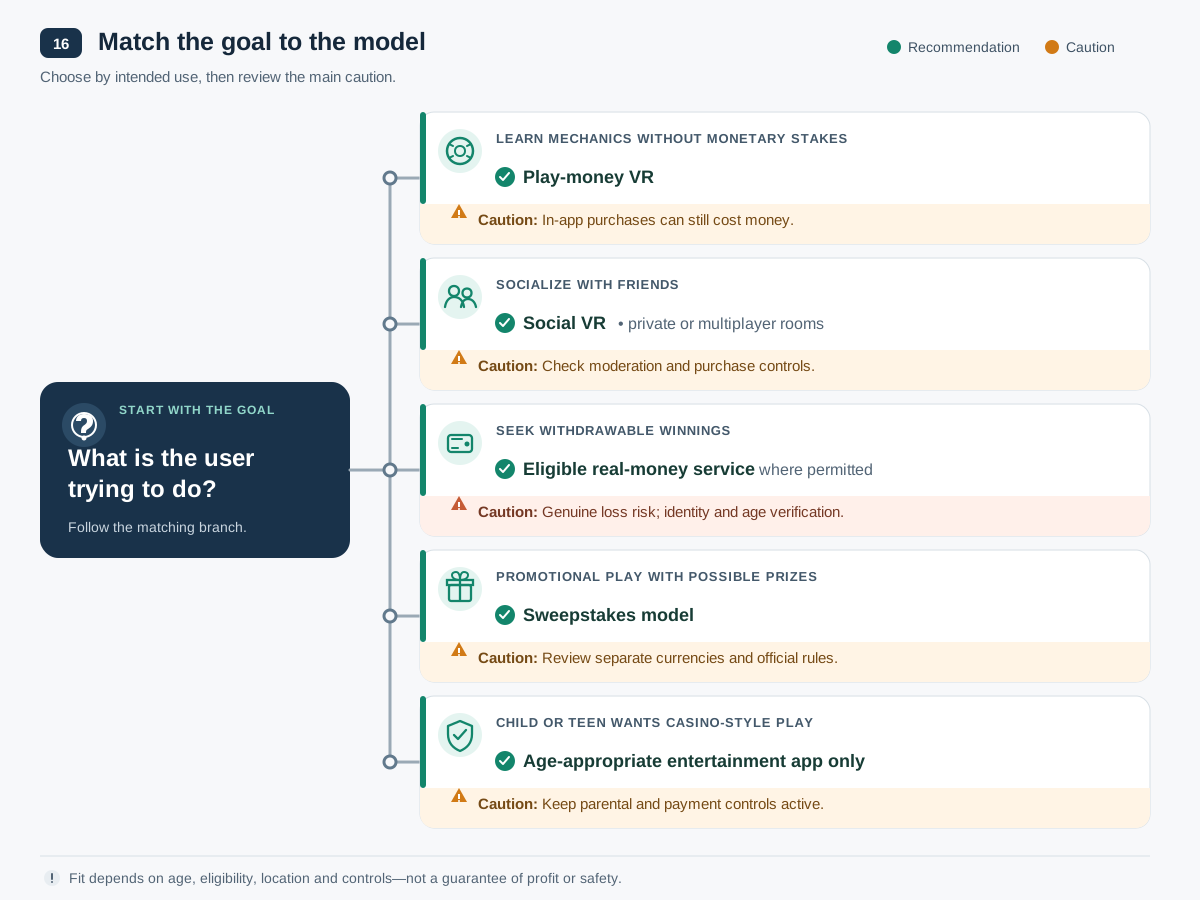
The right model depends on whether the user wants entertainment, realistic practice, social interaction, or the possibility of monetary returns.
Scenario 1: Learning a game without risking money
Best fit: Play-money VR gaming.
A beginner who wants to understand controls, table flow, or basic game mechanics may prefer non-redeemable chips. This can remove direct monetary stakes, although virtual opponents and casual play may not reproduce the behavior found in real-money games.
The user should still check for in-app purchases. “Play money” means the wagers are not cash wagers; it does not necessarily mean the application costs nothing.
Scenario 2: Social play with friends
Best fit: A social VR casino application with private or multiplayer rooms.
The important features are likely to be comfort, communication, moderation, and purchase controls rather than withdrawal options. Users should verify whether chips can be earned for free and whether access to rooms or events requires payment.
Social casino play should not be described as gambling for profit when its chips have no redemption value.
Scenario 3: Gambling for withdrawable winnings
Best fit: An eligible real-money service, where permitted.
This model involves genuine financial loss. Users should confirm operator authorization, account verification requirements, payment methods, withdrawal rules, and responsible-play tools before depositing.
A realistic VR environment can increase immersion, but it does not improve the odds or make gambling a reliable source of income. For practical account and device precautions, use the VR casino safety guide.
Scenario 4: Promotional play with potential prize redemption
Best fit: A sweepstakes model only when the user understands both currencies and the official rules.
The user needs to distinguish entertainment credits from promotional currency and should review eligibility before accumulating a balance. If the redemption process is unclear, the user should not infer cash value from branding or game messages.
Scenario 5: A child or teenager wants a casino-style VR game
Best fit: Only an age-appropriate entertainment application with active parental controls.
A parent or guardian should review the app’s rating, communication features, purchase settings, privacy options, and currency model. Saved payment methods should be protected. The absence of real-money withdrawal does not eliminate spending, social, or content risks.
Safety Checklist Before Paying or Playing
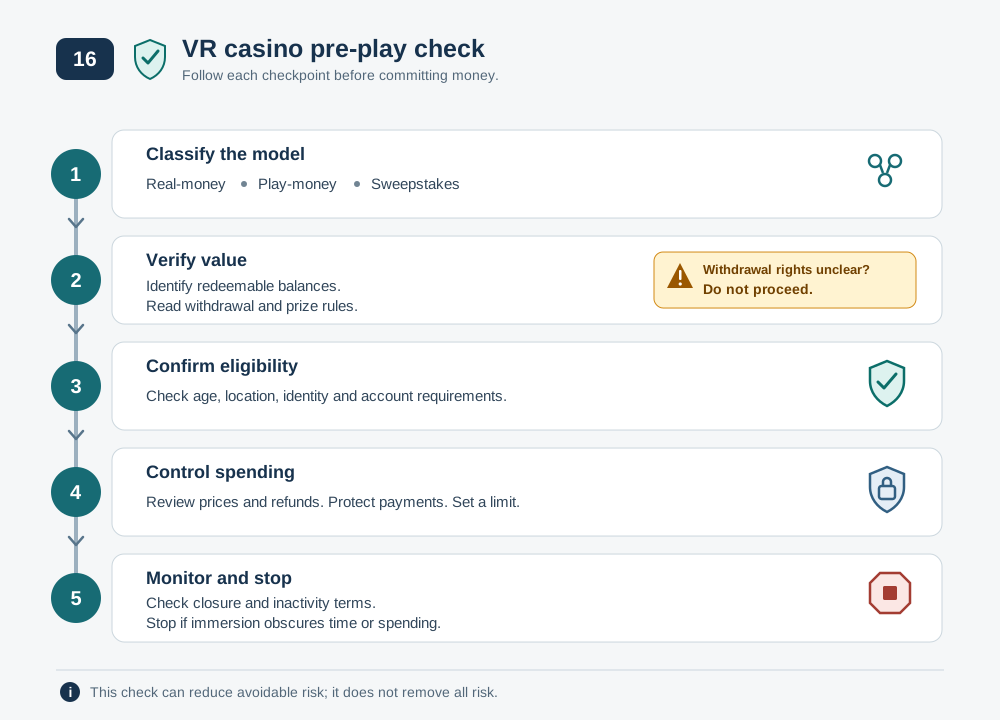
Use this checklist to classify a VR casino application before committing money:
- [ ] Identify whether it is real-money gambling, play-money entertainment, or a sweepstakes promotion.
- [ ] Confirm which balances, if any, can be redeemed.
- [ ] Read the withdrawal or prize-redemption rules.
- [ ] Check age and geographic eligibility.
- [ ] Distinguish deposited funds from bonuses and virtual credits.
- [ ] Review in-app purchase prices and refund terms.
- [ ] Protect purchases with a password, PIN, or biometric approval.
- [ ] Verify identity requirements before depositing a significant amount.
- [ ] Check what happens to balances if the account is closed or inactive.
- [ ] Set a spending limit that treats all purchases and deposits as money spent.
- [ ] Avoid any application that makes withdrawal rights unclear.
- [ ] Stop if immersive play makes it difficult to track time or spending.
The Bottom Line
Real-money, play-money, and sweepstakes VR casinos can look similar inside a headset while operating very differently.
- Real-money casinos accept monetary wagers and may provide withdrawable winnings, subject to eligibility, verification, and account terms.
- Play-money casinos use virtual chips that normally cannot be cashed out, even when users paid to obtain them.
- Sweepstakes casinos may offer a promotional currency with prize-redemption potential, but only under their official rules and eligibility conditions.
- In-app purchases are spending, regardless of whether the purchased item can be withdrawn.
The safest approach is to ignore the visual presentation and classify the underlying transaction. Determine what you pay, what you receive, what can be lost, and what—if anything—can be redeemed.
Frequently Asked Questions
Can play-money VR casino chips be converted into cash?
Normally, no. Play-money chips are generally designed for use inside the application and have no cash-redemption value. Purchasing the chips does not usually change their status. Check the application’s terms for an explicit statement about monetary value and redemption.
Is a social casino the same as a gambling casino?
No. A social casino typically offers casino-style games with non-redeemable virtual currency, while a gambling casino accepts wagers for potentially withdrawable monetary outcomes. A social application can still charge for chips, subscriptions, or digital items.
Are sweepstakes coins the same as deposited money?
Not necessarily. Sweepstakes platforms may use separate entertainment and promotional currencies. Promotional currency may be eligible for prize redemption only after the user meets the official rules. Its presence should not be treated as equivalent to a cash deposit or instantly withdrawable balance.
Does buying virtual chips count as gambling?
Buying non-redeemable virtual chips is different from placing a real-money wager for a monetary prize. However, the precise legal treatment depends on the application’s structure and local rules. From a budgeting perspective, the purchase is still real spending.
Does a VR headset make casino play more or less legitimate?
Neither. VR is an interface, not evidence of authorization or redemption value. Legitimacy must be assessed through the operator, applicable eligibility rules, payment and withdrawal terms, and relevant oversight—not through the realism of the virtual environment.
Can a user withdraw money won in a free mode?
Usually not if the free mode uses ordinary play-money credits. Withdrawal is possible only when the service expressly assigns redemption rights to the resulting balance, such as eligible promotional winnings under sweepstakes rules. Never assume that a displayed “win” is cashable.