Responsible gambling means treating gambling as paid entertainment—not as income, an investment, or a way to recover financial losses. Participation should remain voluntary, affordable, time-limited, and easy to stop.
VR gambling can feel especially absorbing, so decide your limits before entering an experience and use available account controls. If gambling is causing financial pressure, distress, secrecy, conflict, or loss of control, stop participating and contact a qualified support service.
Need help now? Stop gambling, leave the application, and avoid making further deposits or purchases. Ask the operator about account restrictions or self-exclusion, tell someone you trust, and contact a support service in your region. If you or another person is in immediate danger, contact local emergency services.
Responsible Gambling Principles
The following principles apply whether gambling takes place through a VR headset, a mobile device, a computer, or another platform.
Gambling is not a reliable way to make money
Gambling outcomes involve risk, and losses are always possible. Do not treat gambling as employment, financial planning, debt relief, or a dependable source of profit. Never gamble with money required for housing, food, healthcare, education, taxes, debt payments, or other essentials.
Set boundaries before participating
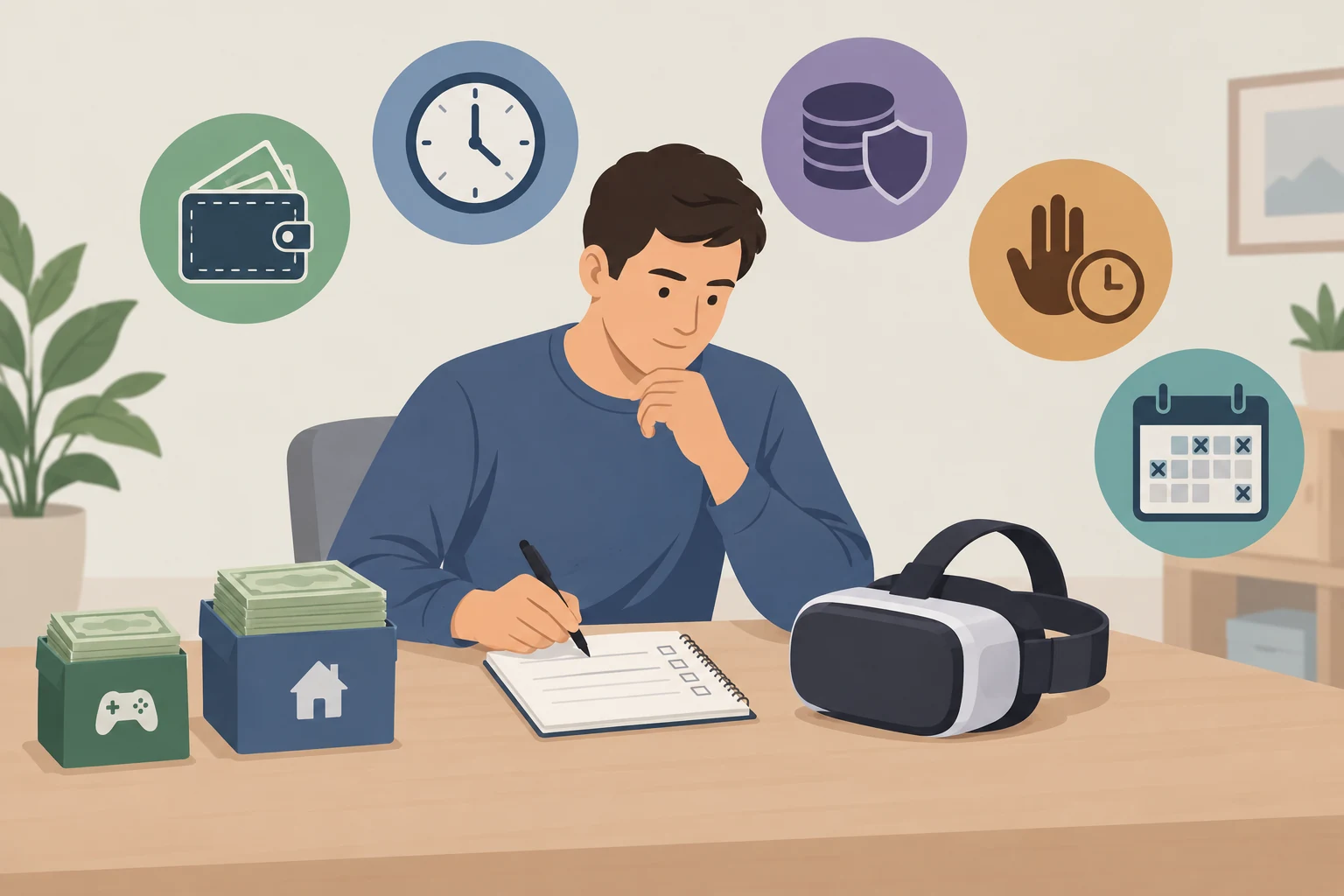
Decisions made before a session are easier to follow than decisions made after a win or loss. Establish:
- a maximum amount you can afford to lose;
- a maximum session length;
- a limit on deposits and purchases;
- a clear stopping time;
- activities or days when you will not gamble.
A limit is not an amount to aim for. It is a boundary that must not be exceeded.
Do not chase losses
Chasing losses means continuing or increasing gambling in an attempt to recover money already lost. Previous losses do not make a future win more likely. If you reach a spending limit, end the session rather than depositing more, raising a stake, or making an additional virtual-currency purchase.
Avoid gambling when judgment may be impaired
Do not gamble while under the influence of alcohol or drugs, or when experiencing acute stress, anger, loneliness, exhaustion, or emotional distress. These conditions can make it harder to follow limits and evaluate risk.
Take regular breaks
VR environments may reduce awareness of time and outside cues. Use alarms, platform reminders, or session limits where available. Remove the headset during breaks and check the actual time and amount spent before deciding whether to continue.
Keep gambling separate from everyday finances
Use only a predetermined entertainment budget. Do not borrow money to gamble, use credit intended for essential expenses, sell possessions, or rely on future income to cover current losses.
Age and Geographic Restrictions
Gambling is for adults who meet the legal minimum age in their location. The applicable age may depend on the country, state, province, territory, gambling product, and operator.
Before participating:
- confirm the legal gambling age where you are physically located;
- check whether the operator is permitted to offer the activity in that jurisdiction;
- review the operator’s eligibility and location requirements;
- do not use another person’s identity, payment method, or account;
- do not attempt to bypass age, identity, or geographic restrictions.
Parents and guardians should not allow children to access gambling accounts, payment methods, or gambling-related purchases. If a minor has accessed a gambling service, contact the relevant operator promptly to request restrictions and information about available safeguards.
Laws and service availability can change. Consult the relevant regulator or licensed operator for current local requirements.
Warning Signs of Problem Gambling
A single sign does not provide a diagnosis, but repeated or escalating patterns may indicate that gambling is becoming harmful. Take concerns seriously even if losses appear manageable.
Financial warning signs
- Spending more than planned or repeatedly raising limits
- Using money needed for bills or essential purchases
- Borrowing, using credit, or selling belongings to continue gambling
- Hiding transactions, losses, deposits, or purchases
- Trying to recover losses through larger or more frequent bets
- Feeling that a win is necessary to solve financial problems
Behavioral warning signs
- Gambling for longer than intended
- Being unable to stop at a planned time or spending limit
- Returning immediately after a loss
- Opening new accounts after restrictions are applied
- Trying to work around self-exclusion or payment blocks
- Neglecting sleep, work, study, relationships, or responsibilities
- Losing interest in activities that are not related to gambling
Emotional and social warning signs
- Irritability, anxiety, guilt, or restlessness linked to gambling
- Frequent thoughts about past sessions or future bets
- Using gambling to escape distress or difficult circumstances
- Arguing with family or friends about time or money spent
- Lying about gambling activity
- Feeling hopeless or panicked because of gambling losses
If several signs apply, do not wait for the situation to become severe. Use account controls, seek support, and consider self-exclusion.
Limits, Self-Exclusion, and Account Controls
Gambling controls vary by operator and jurisdiction. Where available, use several controls together rather than relying on willpower alone.
| Control | What it does | When to use it |
|---|---|---|
| Deposit limit | Caps the amount that can be added during a set period | Before depositing or when spending begins to rise |
| Spending or loss limit | Restricts eligible expenditure or losses | When a fixed entertainment budget is required |
| Stake or wager limit | Caps the amount used per wager or round | To prevent rapid escalation in bet size |
| Session or time limit | Restricts participation time or provides reminders | To reduce extended or unplanned sessions |
| Cooling-off period | Temporarily suspends or restricts account access | When an immediate break is needed |
| Self-exclusion | Blocks access for a selected or prescribed period | When stopping has become difficult or gambling is causing harm |
| Marketing opt-out | Stops or reduces promotional communications | When offers or notifications trigger participation |
| Transaction block | Blocks gambling payments through a bank or payment provider | To add a financial barrier outside the gambling account |
Some limit increases may take effect differently from limit reductions. Read the operator’s terms and ask support staff when a change will become active.
How to put stronger controls in place
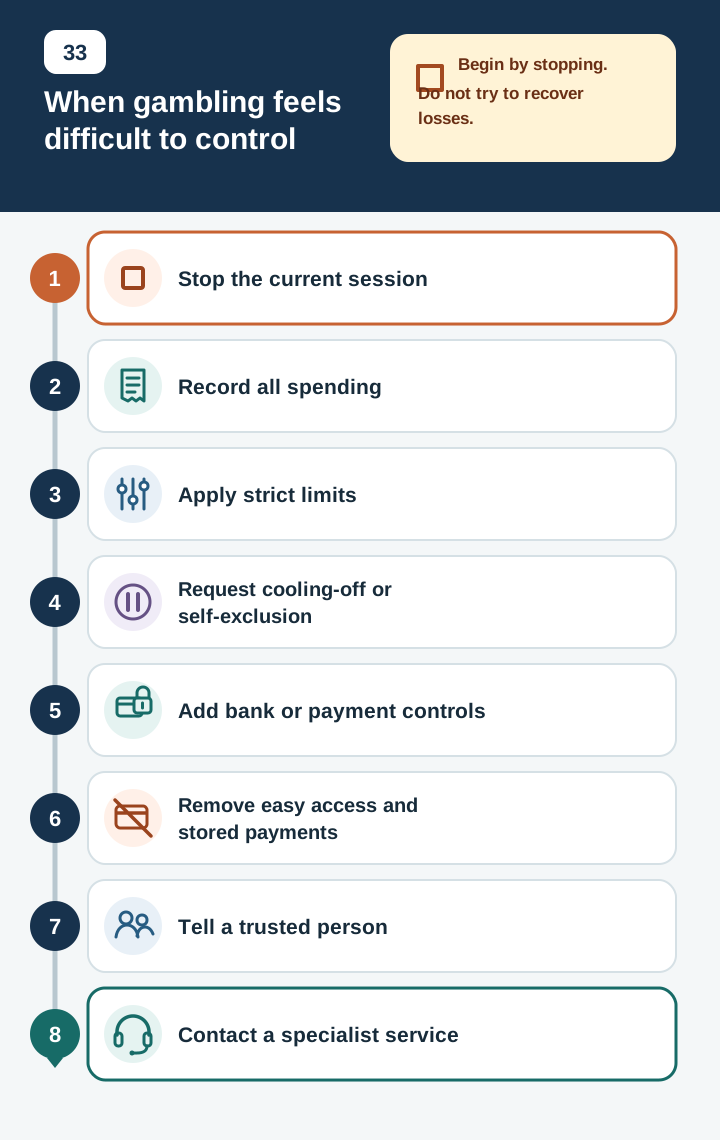
- Stop the current session. Do not try to recover losses before taking action.
- Record the amount spent. Include deposits, wagers, fees, virtual-currency purchases, and other gambling-related payments.
- Apply the strictest useful limits. Lower deposit and spending limits, activate time controls, and disable promotional messages.
- Request a cooling-off period or self-exclusion. Use the operator’s responsible-gambling section or contact its support team.
- Add external payment controls. Ask your bank or payment provider whether it offers gambling transaction blocks.
- Remove easy access. Uninstall relevant applications and remove stored payment methods where appropriate.
- Tell a trusted person. Support from a friend, family member, counselor, or healthcare professional can make restrictions easier to maintain.
- Contact a specialist service. Professional support is appropriate before, during, or after self-exclusion—not only in a crisis.
Self-exclusion is a protective measure, not a punishment. Depending on the jurisdiction, it may apply to one operator, several connected brands, or a broader regulated scheme. Confirm its scope, duration, and reinstatement rules before submitting a request.
Virtual Currency and In-App Purchases
Virtual chips, credits, tokens, and similar balances can make expenditure feel less visible than direct payments. They may still represent money spent, particularly when purchased in bundles or through repeated small transactions.
Use these safeguards:
- check the real-money cost before confirming any purchase;
- count all purchases toward one entertainment budget;
- avoid automatic top-ups and one-click purchases where they can be disabled;
- review receipts and platform transaction histories regularly;
- do not treat bonus balances as a reason to extend a session;
- stop purchasing if the total is difficult to track;
- contact the platform or payment provider if you do not recognize a transaction.
For terminology and the separate distinctions between different participation models, see Real Money vs. Play Money.
Support and Regional Help Resources
Support is available for people who gamble and for family members or friends affected by someone else’s gambling. Services may offer confidential information, counseling referrals, peer support, financial guidance, or help with self-exclusion.
| Region | Support route |
|---|---|
| United States | The National Council on Problem Gambling provides access to the National Problem Gambling Helpline and state-level resources. Call or text 1-800-GAMBLER where available. |
| Great Britain | GamCare provides information and support through the National Gambling Helpline. Call 0808 8020 133. |
| Canada | Contact the problem-gambling service provided by your province or territory. Provincial health services and gambling regulators can direct residents to local counseling and exclusion programs. |
| Australia | Gambling Help Online offers national online support and access to the Gambling Help line at 1800 858 858. |
| New Zealand | Gambling Helpline New Zealand provides support at 0800 654 655. |
| Other regions | Gambling Therapy offers international information and online support. Local healthcare providers and gambling regulators can identify services in your country. |
Availability, operating hours, languages, and phone access can vary. Check the service’s official website for current details. A doctor, licensed mental-health professional, community health service, or local addiction service may also provide assessment and referral.
If gambling-related distress includes thoughts of self-harm or suicide, contact local emergency services or a crisis service immediately. Do not remain alone while waiting for help.
A Practical Stop-and-Seek-Help Checklist
Take action if gambling no longer feels controlled:
- [ ] End the session and make no further deposits or purchases.
- [ ] Activate a cooling-off period or self-exclusion.
- [ ] Lower account limits and block promotional messages.
- [ ] Ask your bank about gambling transaction controls.
- [ ] Tell a trusted person what is happening.
- [ ] Contact a regional gambling-support service.
- [ ] Seek financial or mental-health support when needed.
- [ ] Keep restrictions in place even if the immediate urge passes.
Responsible gambling tools reduce risk, but they cannot guarantee that gambling will remain harmless. If limits repeatedly fail, the appropriate next step is to stop and seek support.
For more information about this publication, visit About VR Casino. For separate guidance on evaluating VR casino environments, see the VR Casino Safety Guide.