VR casinos prioritize immersion, conventional online casinos prioritize convenience, and land-based casinos provide the strongest sense of physical presence. The best format depends on whether you value at-home access, realistic social interaction, a broad game selection, low equipment requirements, or an in-person venue.
In practical terms:
- Choose a VR casino if you want an interactive 3D environment and are comfortable using a compatible headset.
- Choose a conventional online casino if fast access, device flexibility, and game variety matter most.
- Choose a land-based casino if you prefer physical tables, face-to-face interaction, and the atmosphere of a real venue.
These differences affect more than presentation. Equipment, travel, payments, privacy, licensing, accessibility, and the availability of specific games can all vary by format.
VR vs Online vs Land-Based Casinos at a Glance
A VR casino is a virtual-reality environment designed to make players feel present inside a digital casino. A conventional online casino delivers games through a website or mobile app without requiring immersive hardware. A land-based casino is a physical venue containing staffed tables, gaming machines, and other on-site facilities.
| Comparison factor | VR casino | Conventional online casino | Land-based casino |
|---|---|---|---|
| Core experience | Immersive 3D environment viewed through a headset | Screen-based website or app | Physical casino venue |
| Access | Requires compatible software and usually a VR headset | Available through supported computers, phones, or tablets | Requires travel to an operating venue |
| Setup time | Headset setup, account access, and play-area preparation may be needed | Usually quick after account setup and verification | Depends on travel, entry procedures, and venue availability |
| Immersion | High visual and spatial immersion | Low to moderate, depending on game presentation | High physical and sensory immersion |
| Social interaction | Avatars, voice chat, gestures, or shared virtual spaces where supported | Text chat, live-dealer interaction, or limited multiplayer features | Face-to-face interaction with dealers, staff, and other visitors |
| Game control | Motion controllers, hand tracking, gaze controls, or standard inputs, depending on the application | Touchscreen, mouse, keyboard, or standard device controls | Physical chips, cards, buttons, tables, and machines |
| Game selection | Can be limited by the individual VR platform and its development resources | Often broad because games are easier to distribute through websites and apps | Limited to the games and machines installed at the venue |
| Equipment cost | May require purchasing a compatible headset and controllers | Often works on hardware the player already owns | No gaming device required, but travel and on-site expenses may apply |
| Travel cost | None for at-home access | None for at-home access | Transport, accommodation, food, or parking may add to the total cost |
| Physical space | May require a safe seated or standing area | Minimal additional space | No home setup, but attendance at the venue is necessary |
| Availability | Depends on platform support, jurisdiction, and service hours | Often accessible wherever the operator legally accepts players | Restricted by location, opening hours, entry rules, and local law |
| Payments | Usually handled through an account, website, app, or supported platform | Electronic deposits and withdrawals | Cash, cards, venue accounts, or other locally supported methods |
| Identity checks | Common for regulated real-money services | Common for regulated real-money services | May occur at entry, during transactions, or when claiming certain payouts |
| Privacy considerations | Account data plus any information collected by the VR platform or headset ecosystem | Account, device, payment, and browsing-related data may be processed | Physical presence, identification checks, payment records, and venue surveillance may apply |
| Licensing | Real-money activity must be authorized for the relevant market; the VR interface itself does not prove licensing | Operator must hold appropriate authorization for each market served | Venue must be authorized under the laws governing its physical location |
| Best suited to | Players seeking novelty, spatial presence, and virtual social interaction | Players seeking convenience, device flexibility, and game choice | Players seeking a physical night out and direct human interaction |
No format is automatically better, safer, or more legitimate than the others. A polished headset experience does not establish that a VR service is licensed, just as a professional website does not prove that an online operator is authorized. The operator, jurisdiction, terms, and controls must be assessed separately.
Immersion, Interaction, and Social Experience
VR casinos create spatial presence
The defining feature of a VR casino is the feeling of occupying a shared digital space rather than viewing a game through a flat screen. Players may be able to look around a virtual room, approach a table, interact with objects, or see representations of other users.
That can make routine actions feel more physical. Selecting a chip with a controller, turning toward another avatar, or moving between virtual areas introduces a sense of space that a conventional website cannot fully reproduce.
However, immersion also creates friction. A headset must be worn, the application must run reliably, and its controls must be comfortable. Some users experience eye strain, fatigue, disorientation, or motion discomfort. A longer setup process can also make VR less suitable for someone who wants a brief session.
For an overview of setup and basic controls, see the guide to playing VR casino games. Readers interested in the underlying systems can explore VR casino technology separately.
Conventional online casinos favor speed and simplicity
A standard online casino usually presents games as individual pages or app screens. The player selects a title, adjusts permitted settings, and interacts using a mouse, keyboard, or touchscreen.
This format offers less environmental immersion, but that is often an advantage rather than a defect. It minimizes the steps between opening the service and choosing a game. It can also be easier to use discreetly, pause, or leave than an immersive application.
Some conventional platforms add social elements through:
- Live-dealer video streams
- Table chat
- Multiplayer rooms
- Tournaments or shared leaderboards
- Community features
These functions can create interaction, but they do not provide the same spatial presence as VR or the full face-to-face contact of a physical casino.
Land-based casinos provide direct human interaction
Physical venues offer real dealers, tangible equipment, ambient sound, and spontaneous interaction with nearby visitors. They can also include restaurants, shows, bars, hotels, or other facilities that turn a casino visit into a broader leisure activity.
This experience is difficult for digital formats to reproduce. Even a detailed VR room still relies on avatars, networked communication, and simulated objects. A land-based table places everyone in the same physical setting, where expressions, conversation, and table etiquette are directly visible.
The trade-off is reduced control over the environment. Crowds, noise, dress expectations, smoking policies, waiting times, and other visitors’ behavior may affect the experience. A player who prefers privacy or a quiet setting may find home-based formats more comfortable.
Social does not always mean comfortable
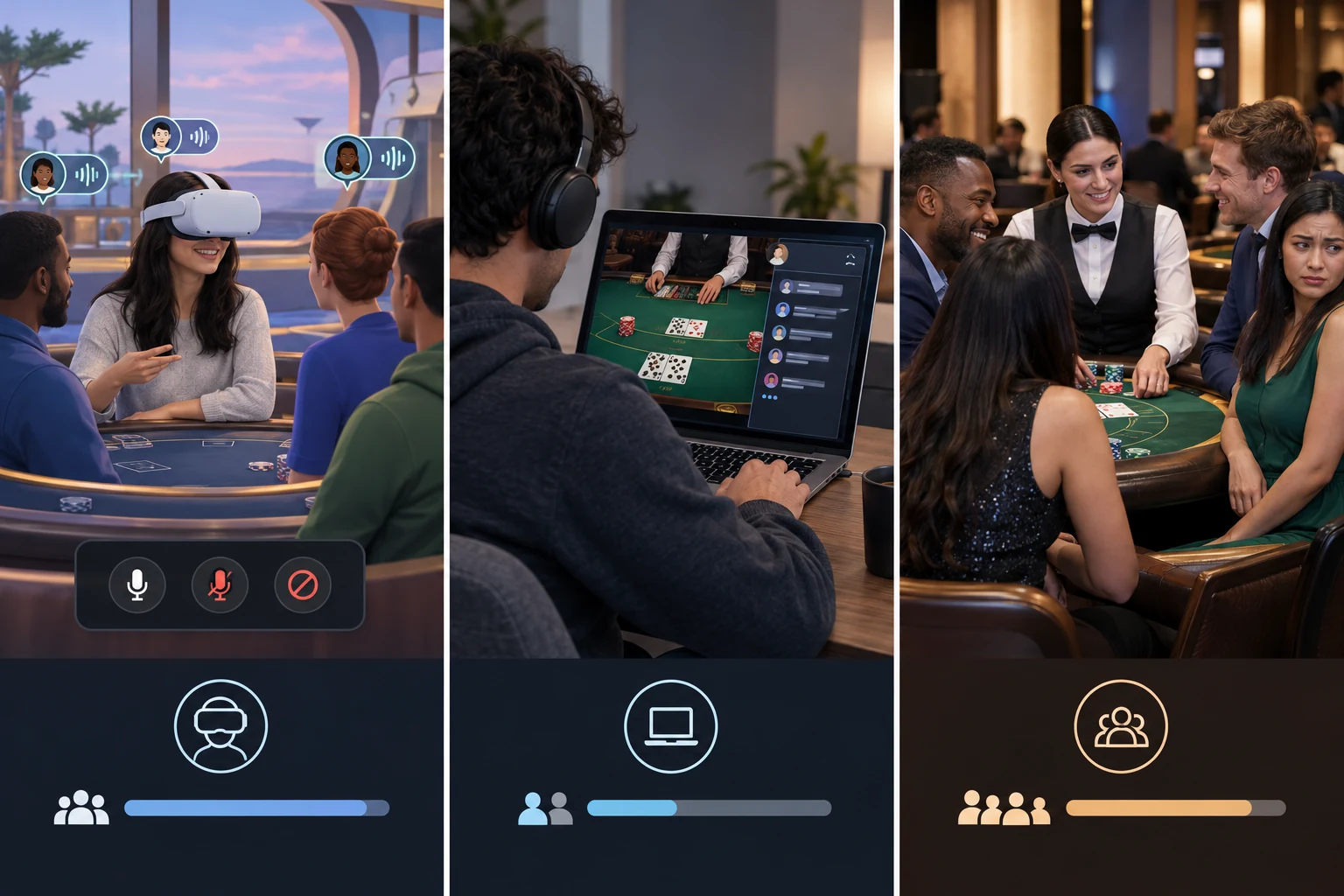
Each format creates different social pressures:
- VR: Voice chat and avatar interaction can feel engaging, but moderation quality and user conduct vary.
- Conventional online: Interaction is often optional or easy to minimize.
- Land-based: Communication is immediate and natural, but it can be difficult to avoid attention at a shared table.
Players should consider whether they want active conversation, passive company, or a largely solitary experience. The most socially advanced option is not necessarily the best option for every user.
Access, Equipment, Cost, and Game Choice
Device and location requirements
VR has the highest hardware threshold of the three formats. A supported headset is generally required, sometimes with controllers and enough clear space to use them safely. Compatibility depends on the application, operating ecosystem, and region.
Conventional online casinos have the lowest dedicated equipment requirement. Many operate through web browsers, while others offer mobile or desktop applications. Device age, screen size, connection quality, and software support can still affect performance.
Land-based casinos require no personal gaming hardware, but access depends on geography. The nearest authorized venue may be nearby, several hours away, or unavailable in the player’s jurisdiction. Entry may also be restricted by age, identification requirements, operating hours, or venue rules.
The true cost extends beyond wagers
The cost of each format should be evaluated as a combination of access expenses and gambling expenditure.
VR casino costs may include:
- A compatible headset
- Controllers or related accessories
- A computer or console for applications that do not run independently
- Paid software or platform charges, where applicable
- Replacement accessories and general device upkeep
A person who already owns suitable equipment faces a different cost calculation from someone buying a headset primarily for casino-style entertainment.
Conventional online casino costs may include:
- Internet access
- An existing phone, tablet, or computer
- Payment-processing or currency-conversion charges where disclosed
- Optional app or platform costs
Because many users already own compatible devices, the additional access cost can be comparatively low.
Land-based casino costs may include:
- Transportation
- Parking
- Accommodation
- Food and drinks
- Venue entry or entertainment expenses, where applicable
- Time spent traveling
Land-based play avoids headset costs, but a single trip can involve expenses unrelated to the game itself. Those costs matter when comparing formats.
Game selection varies by provider and venue
Conventional online casinos commonly have the broadest potential catalog because digital games can be distributed without allocating physical floor space. A platform may offer multiple versions of slots, table games, live-dealer games, and specialty titles, although the actual selection depends on its suppliers, licensing arrangements, and local availability.
Land-based venues must decide how to use finite floor space. They may offer many machines while operating fewer tables for games with lower demand. Some tables may open only at particular times or when enough staff and players are available.
VR catalogs are shaped by a different constraint: games must be designed or adapted for an immersive interface. A standard browser game does not automatically become a complete VR experience. As a result, a VR platform may emphasize a smaller number of interactive environments or social tables rather than a very large catalog.
Players should therefore check for the games they actually want instead of comparing headline totals. Useful questions include:
- Is the preferred game available in the player’s location?
- Does it work natively in VR, or is it simply displayed on a virtual screen?
- Are multiplayer tables active at the intended time?
- Does the venue regularly operate the desired physical table?
- Are the applicable rules and limits visible before play?
Those interested in trying immersive formats without focusing on operator rankings can review the available categories of free VR casino games.
Accessibility is individual, not universal
At-home access can benefit people who cannot easily travel to a venue. Conventional online interfaces may also support device-level accessibility tools, adjustable screen settings, or alternative input methods.
VR introduces both opportunities and barriers. Spatial audio, seated modes, subtitles, control remapping, and other features may help some users, but support varies by application. Headset weight, visual requirements, controller dexterity, motion sensitivity, and the need to orient within a 3D space may create difficulties for others.
Land-based venues may provide accessible entrances, seating, restrooms, and staff assistance, but the quality of access differs by property and jurisdiction. Physical distance between facilities, crowded floors, table height, lighting, and noise can also matter.
A player with specific accessibility needs should verify support directly rather than assuming that digital access is automatically accessible.
Payments, Privacy, and Regulatory Differences
Payment methods follow the operator, not just the format
VR does not create a distinct universal payment system. A VR casino may route account registration, deposits, or withdrawals through a conventional website, companion application, platform account, or another supported interface. The available methods depend on the operator and jurisdiction.
Conventional online services commonly process transactions through registered player accounts. Before using one, players should review:
- Supported deposit and withdrawal methods
- Processing conditions
- Minimum and maximum transaction rules
- Identity-verification requirements
- Currency conversion
- Disclosed charges
- Withdrawal restrictions in the operator’s terms
Land-based casinos can support cash transactions as well as cards or account-based methods, subject to local rules and venue policy. Larger or unusual transactions may require identification or additional checks.
The visual format does not determine whether transactions are efficient. Payment reliability depends on the operator, financial providers, verification process, account status, and applicable law.
Privacy risks differ rather than disappear
All three formats involve privacy considerations, but the data and environment are different.
A conventional online operator may process account information, identity documents, transaction records, device information, and usage data. The precise categories depend on the service and its privacy policy.
A VR service may involve the same account and payment information while also operating through a headset platform. Depending on the hardware, software, permissions, and features used, additional interaction or device data may be processed. Players should review both the casino operator’s privacy terms and the relevant VR platform permissions.
A land-based venue reduces some forms of remote device tracking, but it is not anonymous by default. Casinos may use security cameras, request identification, maintain transaction records, or operate membership programs. Local regulatory and security obligations can also require recordkeeping.
Before choosing any format, check:
- Who operates the service or venue
- Which entities process account and payment information
- What permissions the application requests
- Whether voice chat can be muted or recorded under the applicable policy
- How to use privacy, blocking, and reporting controls
- How long account or transaction information may be retained, if disclosed
Licensing must match the activity and jurisdiction
Licensing is not a feature that can be inferred from graphics, popularity, or physical appearance. It is a legal authorization associated with an operator or venue and the market in which it operates.
For a VR or conventional online casino, verify that:
- The operator clearly identifies its legal entity.
- Licensing information names the responsible regulator.
- The authorization applies to the player’s location.
- The regulator’s official records can be used to confirm the claim.
- Game rules, account terms, and complaint procedures are available.
For a land-based casino, authorization is tied to the physical venue and local legal framework. A legal venue in one location does not establish that online or VR services using a similar brand are authorized elsewhere.
Availability also changes across jurisdictions. An application may be downloadable while real-money activity remains restricted. Likewise, owning a headset does not guarantee that a particular VR casino can legally accept a player.
This comparison does not replace local legal guidance. Players should consult the relevant regulator or official government information when eligibility is uncertain.
Safety depends on controls and conduct
No delivery format eliminates financial risk. Immersive environments can make time feel less prominent, while rapid online access can make repeated play easy. Land-based venues can create social momentum and make it inconvenient to step away from a table.
Useful controls include:
- Predetermined spending limits
- Time limits and session reminders
- Deposit or loss limits where offered
- Account time-outs or self-exclusion tools
- Muting or leaving socially pressuring environments
- Keeping gambling funds separate from essential expenses
The distinction between wagering and non-wagering access is a separate decision from the choice of VR, conventional online, or land-based play. See the dedicated real-money and play-money comparison for that topic.
Which Casino Format Fits Your Use Case?
Choose VR when immersion is the priority
VR may fit players who:
- Already own compatible equipment
- Want to explore a casino-like 3D environment
- Enjoy voice chat, avatars, and shared virtual spaces
- Prefer at-home access without giving up a sense of spatial presence
- Are comfortable learning motion-based or headset controls
It may be a poor fit for anyone who experiences headset discomfort, wants the widest possible game catalog, or prefers instant access from an ordinary phone or browser.
Choose a conventional online casino for convenience
A standard website or app may be the strongest option when the priorities are:
- Quick access
- Compatibility with everyday devices
- A potentially broad selection of games
- Private or low-interaction sessions
- Easy switching between games
- No travel or headset setup
The compromise is a less immersive environment. Even live-dealer games are viewed through a screen rather than experienced in a shared physical or virtual space.
Choose a land-based casino for a physical outing
A land-based venue may be suitable when the player wants:
- Face-to-face interaction
- Physical cards, chips, tables, or machines
- A social event rather than only a gaming session
- On-site entertainment, dining, or hospitality
- Direct assistance from venue staff
It may be less suitable when travel is difficult, privacy is important, crowds are uncomfortable, or the desired game is not available when visiting.
A practical decision checklist
Use these questions to narrow the choice:
-
Do you want an activity or a destination?
VR and online casinos bring games home; a land-based casino is a place to visit. -
How important is immersion?
Choose VR for digital spatial presence or land-based play for physical presence. Choose conventional online play if immersion is secondary. -
What equipment do you already own?
Existing VR hardware can make immersive access more practical. Without it, online play has the lowest additional hardware barrier. -
How much social interaction do you want?
Land-based tables provide direct contact, VR can provide avatar-based interaction, and conventional online play is usually easiest to keep private. -
Is a specific game essential?
Confirm actual availability before registering, downloading an application, or traveling. -
What are the total non-gambling costs?
Compare hardware and software needs with transport, accommodation, and other venue expenses. -
Is the operator or venue authorized?
Verify licensing through the responsible regulator rather than relying on promotional claims. -
Can you use the format comfortably?
Consider headset tolerance, controls, visual presentation, venue noise, mobility, and accessibility support.
Readers who decide that immersive play fits their needs can continue to the VR casino selection guide to learn which evaluation criteria matter. The comparison here does not rank individual operators.
Frequently Asked Questions
Is a VR casino the same as an online casino?
A VR casino is usually a form of online or networked casino experience, but it uses an immersive 3D interface rather than a standard website or mobile screen. It may also support spatial movement, avatars, voice chat, and motion-based controls. Its account and payment systems can still resemble those of conventional online services.
Do all VR casinos require a headset?
A complete VR experience generally requires compatible virtual-reality hardware. Some services may offer a desktop mode or display conventional games within a virtual environment, but that is not equivalent to full headset-based interaction. Requirements should be checked for each application.
Can VR fully replace a land-based casino?
VR can reproduce visual environments, shared tables, and some social interaction, but it cannot fully duplicate physical travel, tangible equipment, face-to-face communication, or the wider hospitality experience of a venue. Whether that matters depends on what the player values.
Which format usually has the most games?
Conventional online casinos often have the greatest potential variety because digital titles can be added without using physical floor space or being rebuilt as fully interactive VR experiences. Actual catalogs vary, however, and local restrictions can remove games from otherwise large libraries.
Is VR safer than visiting a casino?
Not inherently. VR avoids travel and some physical-venue concerns, but it introduces account, platform, privacy, equipment, and immersive-session risks. Safety depends on licensing, security practices, personal limits, privacy controls, and responsible use—not on the display format alone.
Can the same license cover VR and conventional online play?
That depends on the jurisdiction, operator, and regulated activity. A VR interface does not create authorization by itself, and a license displayed for one service may not apply to every product or location. Confirm the operator and authorization through the relevant regulator’s official records.