A Malta Gaming Authority casino licence can authorise a named legal entity to provide specified gambling services under Malta’s regulatory framework. It does not automatically cover every brand, domain, game, supplier or country in which the operator may wish to accept players.
To assess a casino claiming Malta licensing, check the Malta Gaming Authority’s official records rather than relying on an MGA logo or licence number displayed by the operator. The official record should confirm:
- the licence holder’s exact legal name;
- the current licence status;
- the authorised gaming services or game types;
- the relevant brand and domain, where recorded;
- whether the licence belongs to the operator or to another group company; and
- whether the casino accepts players from the user’s location lawfully.
These checks are particularly important for virtual reality casinos. A VR interface does not create a separate gambling category: the underlying games, operator, software supply, player accounts and payment arrangements remain subject to the applicable licensing requirements.
What the Malta Gaming Authority Regulates
The Malta Gaming Authority, commonly abbreviated as MGA, regulates gambling activities that fall within Malta’s legal and regulatory jurisdiction. Its responsibilities include licensing eligible operators and suppliers, supervising compliance, protecting players, monitoring gaming integrity and taking enforcement action where necessary.
For online casino users, the most relevant authorisation is generally a business-to-consumer gaming service licence held by the company that contracts with players. Companies providing certain essential gaming technology to licensed operators may instead require a business-to-business critical gaming supply licence.
The distinction matters because a supplier’s authorisation is not the same as an operator’s permission to offer casino gambling directly to players.
| Regulatory role | Typical relationship with players | Relevant MGA authorisation |
|---|---|---|
| Casino operator | Registers players, holds player accounts and provides games | B2C Gaming Service Licence |
| Critical gaming supplier | Supplies essential game or control systems to operators | B2B Critical Gaming Supply Licence |
| Brand or front-end provider | May supply presentation, marketing or non-critical technology | Depends on its functions and contractual role |
| VR platform or software developer | May provide only an interface, or may control regulated gaming components | Depends on whether its services constitute gaming supply or operation |
An MGA licence is attached to an authorised legal entity and regulated activities. The presence of a Malta-registered company somewhere within a corporate group does not establish that every group brand or product is licensed.
Remote casino activity
A remote casino normally provides games through websites, mobile applications or other connected systems. Delivery through a VR headset can still be remote gaming when players participate through electronic communication and the gambling service is operated online.
The regulatory analysis therefore looks beyond the visual format. Relevant questions include:
- Who enters into the gambling contract with the player?
- Which company registers and verifies the player?
- Who holds or controls the player’s balance?
- Which entity determines the game rules and payouts?
- Who supplies the random number generator or live gaming system?
- Which domains, applications and brands are associated with the service?
- Where are players located and permitted to participate?
A virtual casino lobby, three-dimensional table or headset-based interface may change how a game is presented, but it does not remove the underlying regulated activity.
Relevant Malta Casino Permissions
Malta’s framework separates authorisation by business role and by the type of gaming activity provided. A casino claim should therefore be assessed at both levels.
B2C Gaming Service Licence
A B2C Gaming Service Licence is relevant when a company provides a gambling service directly to consumers. The licensed entity is responsible for regulated areas such as player registration, account management, responsible gambling controls, complaints and compliance with applicable technical and operational requirements.
For verification purposes, the central question is whether the company named in the casino’s terms and conditions is the same entity shown as the authorised operator in the MGA’s records.
A business name alone is not sufficient. Casino brands often differ from the legal names of the companies operating them.
B2B Critical Gaming Supply Licence
A B2B Critical Gaming Supply Licence applies to the provision of specified critical gaming supplies rather than the direct provision of gambling to consumers. Depending on the system, this may include technology essential to determining game outcomes or operating regulated gaming processes.
A supplier licence should not be presented as if it were a consumer-facing casino licence. If a VR developer holds a supply authorisation, that fact does not by itself prove that the developer may accept player deposits, maintain gambling accounts or offer games directly to the public.
The operator using the supplied system should have its own appropriate authority to provide the gaming service.
MGA game types relevant to casinos
MGA authorisations identify the permitted gaming activity. The framework uses game types that distinguish between different methods of determining outcomes and different relationships between the operator and players.
| Game type | General description | Common examples |
|---|---|---|
| Type 1 | Games played against the house where the outcome is determined by a random generator | Slots and RNG-based casino games |
| Type 2 | Games based on an event or competition where the operator manages risk through fixed odds | Fixed-odds betting, including live betting |
| Type 3 | Games in which players compete against other players and the operator earns a commission or similar charge | Peer-to-peer poker, bingo and betting exchange models |
| Type 4 | Controlled skill games where skill is a significant factor in determining the outcome | Qualifying controlled skill games |
The examples are useful guides, but the authorised activity shown in the official record is more important than the marketing label used by a casino. A game described as “interactive,” “social,” “immersive” or “VR” must still fit the relevant regulated category.
A licence covering one game type should not be assumed to cover every other product offered by the same business. An operator adding a materially different gaming vertical may need further regulatory assessment or approval.
How Malta Licensing Applies to VR Casino Operators
The MGA does not need a separate category simply because gambling is presented in virtual reality. The operator’s role, gaming activity and technology determine which permissions and compliance obligations are relevant.
Three common VR business models illustrate the distinction.
1. A licensed casino adds a VR interface
An existing B2C operator may allow players to enter its casino through a headset while using the same accounts, balances and underlying games available through its website or application.
In this model, the operator should assess whether the VR channel, software and connected domains fall within its approved operations. Material technical changes, new game delivery systems or additional suppliers may require regulatory review under the applicable framework.
Players should still be able to identify the licensed operator clearly. The immersive environment should not obscure access to terms, responsible gambling tools, account information or complaint procedures.
2. A VR company supplies technology to casino operators
A software company may build the virtual lobby, avatars, multiplayer environment or game integration layer without operating the gambling service itself.
Its licensing position depends on what the technology does. A purely presentational interface may be treated differently from software that controls game outcomes, player funds or other critical gaming functions. The contractual description of the service is not decisive if the supplier’s actual technical role is broader.
Where the technology constitutes critical gaming supply, the relevant B2B authorisation may be required. The consumer-facing casino operator remains responsible for holding the appropriate B2C permission.
3. A VR brand operates the entire casino
If the VR company registers players, accepts wagers, maintains balances and provides the games, it is acting as the operator rather than merely as a software supplier. It would need the appropriate B2C authority for the gaming services offered.
Outsourcing game content, hosting, identity checks or payments does not necessarily transfer the operator’s regulatory responsibility to those providers.
Practical VR compliance questions
A VR operator or reviewer should be able to answer the following:
- Is the player contracting with the licensed entity?
- Are the games within the authorised game types?
- Is the VR product connected to an approved brand, domain or delivery channel?
- Are critical suppliers appropriately authorised where required?
- Can players access age restrictions, terms and responsible gambling controls inside or alongside the VR service?
- Do session controls and account restrictions function across web, mobile and headset access?
- Is the same player balance used across channels, and which entity controls it?
- Does the operator lawfully accept players from each target market?
- Are updates to the VR client assessed for regulatory and technical impact?
The answers may require both regulatory and technical review. A licence badge cannot resolve these questions by itself.
How to Verify an MGA Casino Licence
Use the Malta Gaming Authority’s official website and current records for verification. Do not treat an operator’s footer badge, certificate image or copied licence number as independent evidence.
A broader verification process is available in our guide to checking an online gambling licence.
Step-by-step MGA licence check
-
Identify the casino’s legal operator.
Open the terms and conditions, privacy notice, account page or payment terms. Record the full company name, company number if supplied, registered address, brand name and claimed MGA licence number. -
Search the MGA’s official Licensee Register.
Search using the exact legal entity name. If necessary, also search by the displayed licence reference, brand or website address. Use the regulator’s live records rather than a search-engine snippet or third-party directory. -
Confirm the licence status.
Check that the authorisation is current. A record showing suspension, cancellation, termination or another restriction should not be treated as an active unrestricted licence. Read any linked regulatory notice where available. -
Match the legal entity exactly.
Compare the company named in the MGA record with the company identified in the casino’s terms. Similar names, shared directors, common branding or membership in the same corporate group are not substitutes for an exact match. -
Check the authorised service and game types.
Confirm that the record covers B2C gaming services if the company offers gambling directly to players. Review the authorised game types and compare them with the products offered. -
Match the domain and brand.
Verify that the website or brand is associated with the licensee in the official record where the MGA provides that information. Check the full domain carefully, including spelling and top-level domain. A lookalike address may be unauthorised even when it copies a legitimate operator’s branding. -
Review official warnings and enforcement information.
Search the MGA website for notices concerning the company, domain or licence reference. The regulator may publish warnings about false licensing claims or entities that have no connection with the MGA. -
Check the VR route separately.
Determine whether the headset application connects to the verified operator and domain. Review the application publisher, login destination, terms, account system and payment recipient. A legitimate website does not automatically authenticate an unrelated VR application using the same brand name. -
Check geographic eligibility.
Read the operator’s restricted-country rules and determine whether the service may accept players from your location. MGA authorisation alone does not override the laws or licensing requirements of another market. -
Save evidence if there is a problem.
Keep the URL, terms, licence claim, transaction records and screenshots of relevant account information. Current official records should then be checked again before raising the issue with the operator or regulator.
Quick verification checklist
A credible MGA licensing claim should satisfy all of these core checks:
- [ ] The operator’s full legal name is disclosed.
- [ ] The entity appears in the official MGA Licensee Register.
- [ ] The licence is currently active and not subject to a relevant restriction.
- [ ] The authorisation covers B2C services if the business accepts players directly.
- [ ] The games offered fit the authorised game types.
- [ ] The casino’s domain or brand is connected to the licensee.
- [ ] The VR application leads to the same verified operator and account system.
- [ ] No official warning contradicts the casino’s claim.
- [ ] The operator accepts players from the relevant location.
- [ ] Payments and terms identify the expected licensed entity.
A failed check does not always prove deliberate misconduct. It does mean the licensing claim needs clarification before the service should be treated as verified.
Licence Boundaries and Common Errors
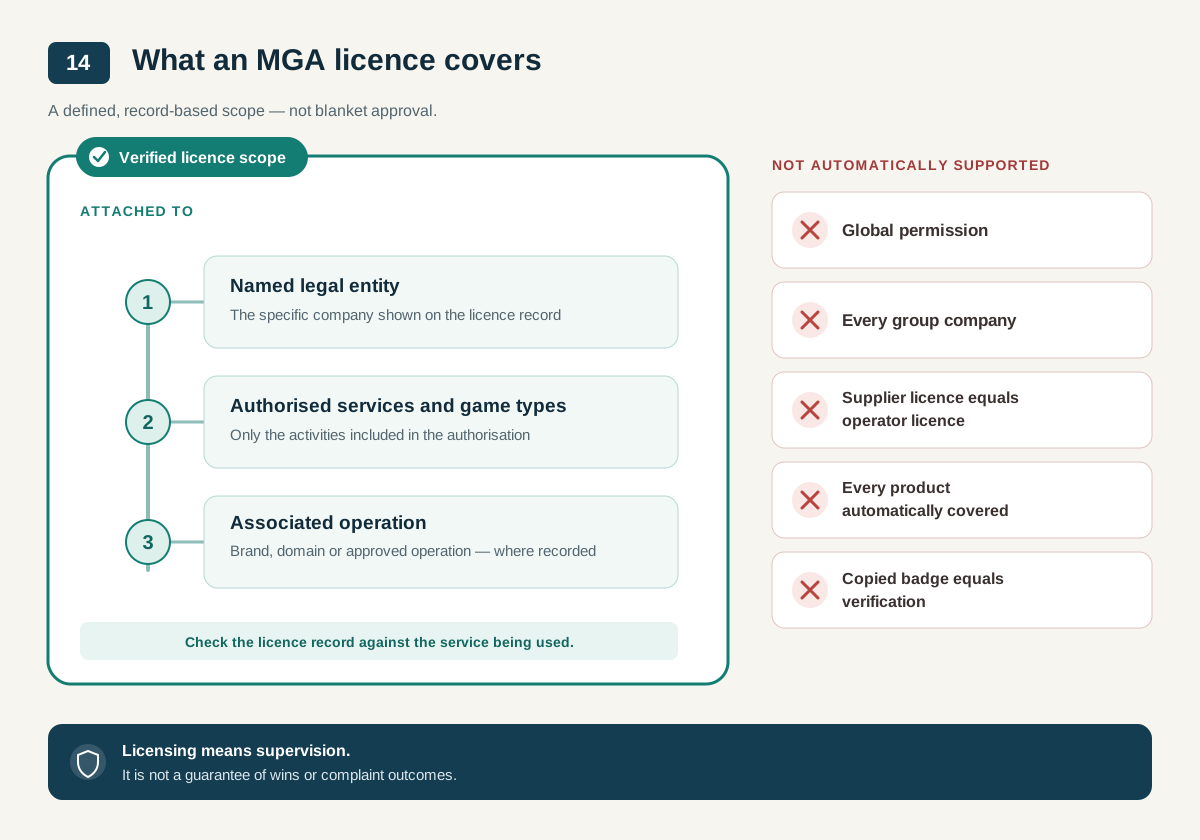
An MGA licence has defined legal and operational limits. Understanding those limits prevents several common misinterpretations.
A licence is not global permission
Malta authorisation does not automatically give an operator the right to target every country. Gambling rules differ by player location, and some markets require local permission or restrict remote gambling entirely.
Players and operators must consider both the MGA authorisation and the rules applicable in the target market.
One licensed company does not cover every related company
Corporate groups may contain multiple subsidiaries with different functions. One entity may hold the licence while another provides marketing, payments, software or intellectual property.
The company contracting with the player must be identified. A group relationship should not be used to imply that an unlicensed entity holds the same permissions as the actual licensee.
A supplier licence is not an operator licence
A business authorised to supply critical gaming technology is not necessarily authorised to run a consumer casino. Conversely, an operator licence does not establish that every external supplier has any authorisation required for its role.
Check each entity according to the activity it performs.
A licence does not cover every product automatically
The official permission should correspond to the offered gaming services. Adding poker, betting, controlled skill games or a materially different VR product may raise questions beyond an existing casino authorisation.
The product’s substance matters more than its label. Calling a wager-based product a “VR experience” does not place it outside gambling regulation.
A badge is not verification
Licence logos and seals can be copied, displayed incorrectly or linked to unrelated records. Even a genuine licence number may belong to another company.
Verification requires a direct match among the regulator’s record, the legal entity, the service, the brand and the domain.
Licensing is not a guarantee of outcome
Regulatory authorisation indicates that an entity has been licensed for defined activities and remains subject to supervision. It does not guarantee that a player will win, that every complaint will be decided in the player’s favour or that a service is suitable for a particular person.
Players should still review game rules, withdrawal conditions, identity requirements and responsible gambling controls before depositing.
What to Do If the MGA Claim Does Not Match
If a casino’s claim differs from the official record, stop and identify the exact discrepancy.
Contact the operator and request a written explanation when:
- the terms name a different company from the MGA record;
- the licence number returns no result;
- the casino domain is not connected to the displayed licensee;
- the record covers different activities from those offered;
- the VR application has a different publisher or payment recipient; or
- the operator claims that a related company’s licence covers it without showing the legal basis.
For a suspected false MGA claim, preserve the relevant evidence and consult the Malta Gaming Authority’s official notices and reporting channels. Do not rely solely on assurances from customer support.
For context on how regulator records, legal entities and domains fit together, visit the online gambling licensing hub.
Malta Casino Licence Questions
Does an MGA licence cover a VR casino?
It can cover casino services delivered through VR when the licensed entity, authorised game types, approved operations and relevant technology arrangements encompass that service. VR presentation alone neither grants nor removes the need for licensing.
Can a casino use another company’s MGA licence?
A brand may be operated by a licensed company even when the brand name differs from the company name. However, an unrelated business cannot rely on another entity’s licence. The casino’s terms, official MGA record and associated domain should establish the connection.
Is an MGA licence number enough to verify a casino?
No. The number must match a current official record, the correct legal operator, the relevant gaming service and the casino’s domain or brand. A copied or outdated number is not proof of authorisation.
Should a VR software studio have an MGA licence?
It depends on its role. A studio providing only non-critical presentation technology may be treated differently from a supplier controlling game outcomes or other critical gaming functions. A studio that accepts players and wagers as the operator requires the relevant B2C authority.
How often should a licence be checked?
Check before registration or deposit, and again if the operator changes its legal entity, domain, terms, payment recipient or product structure. Because licence statuses and authorised operations can change, current official records take priority over previously saved information.