An online casino that provides remote gambling to consumers in Great Britain generally needs an operating licence from the UK Gambling Commission (UKGC). For casino games delivered through a website, mobile app, desktop client or virtual-reality headset, the central permission is usually a remote casino operating licence.
The licence must belong to the legal entity that actually provides the gambling facilities. A UK-facing brand, domain or VR application should therefore be checked against the Commission’s official public register—not merely trusted because it displays a UKGC logo or licence number.
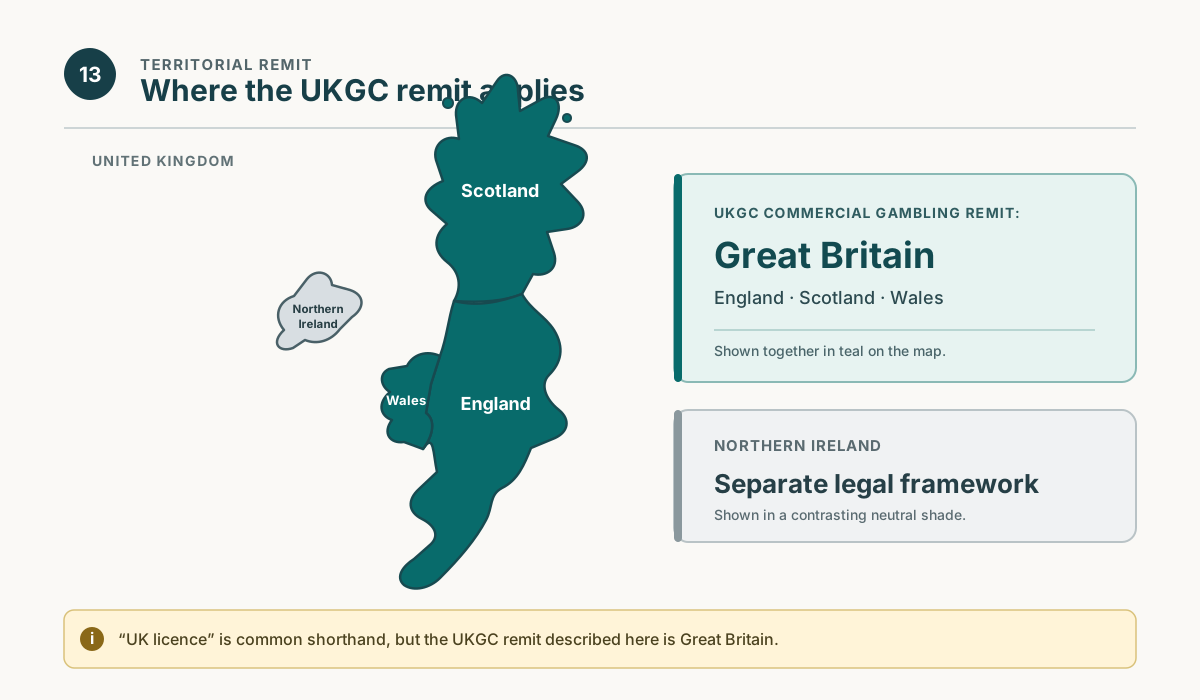
This guide covers commercial remote casino regulation in Great Britain: England, Scotland and Wales. Northern Ireland has a separate legal framework, so “UK licence” is common shorthand but not a precise description of the UKGC’s territorial remit for commercial online gambling.
What the UK Gambling Commission regulates
The UK Gambling Commission is the statutory regulator responsible for most commercial gambling in Great Britain. Its work includes:
- issuing operating and personal licences;
- assessing whether applicants are suitable to hold a licence;
- setting licence conditions and codes of practice;
- establishing technical standards for remote gambling systems and games;
- monitoring licensed businesses;
- investigating suspected non-compliance;
- imposing regulatory sanctions where appropriate;
- requiring measures intended to prevent gambling-related harm, crime and unfair practices.
The principal legislation is the Gambling Act 2005, as subsequently amended. Detailed obligations are also contained in the Commission’s Licence Conditions and Codes of Practice (LCCP) and Remote Gambling and Software Technical Standards (RTS).
When a remote operator needs UKGC permission
A business generally needs the relevant UKGC remote operating licence if it provides facilities for remote gambling to consumers in Great Britain. This can apply even when:
- the operator is incorporated outside Great Britain;
- its employees work abroad;
- its servers or other gambling equipment are located elsewhere;
- the casino uses a third-party platform;
- the games are accessed through a VR headset rather than a conventional screen.
The customer market and the activity being offered matter more than the visual interface. Calling a product a “metaverse,” “social world” or “immersive entertainment platform” does not remove licensing requirements if users are staking value on games of chance for the opportunity to win money or money’s worth.
A licence also does not automatically make an operator lawful in every country. UKGC authorisation concerns the Great Britain market; operators and users may face different rules based on their own location and circumstances.
Remote casino licence categories and related permissions
There is no separate licence category called a “VR casino licence.” A VR service is assessed through the existing framework according to the gambling activities performed and the parties responsible for them.
| Permission | What it covers | When it may be relevant |
|---|---|---|
| Remote casino operating licence | Providing casino games through remote communication | The core permission for a real-money online or VR casino serving consumers in Great Britain |
| Remote gambling software operating licence | Manufacturing, supplying, installing or adapting gambling software in circumstances covered by the licensing regime | A studio or technology supplier that provides gambling software to licensed operators |
| Personal management licence | Certain specified management functions within a licensed gambling business | Senior personnel responsible for areas such as strategy, finance, compliance, marketing or technology, subject to the applicable rules and exemptions |
| Non-remote casino operating licence | Providing casino gambling in a physical, non-remote environment | Relevant to land-based casino activity, not a substitute for remote permission |
| Premises licence | Authorising gambling at particular physical premises through the relevant local authority | May be needed for land-based operations but does not authorise a remote casino service |
A business may need more than one permission. For example, one company might operate the consumer-facing casino while another develops or supplies the underlying game software. The licence required by each entity depends on what that entity actually does, not simply how the commercial arrangement is described.
Operating company versus brand
Casino brands and licensed companies are not always identical. A website or VR application may use a public-facing brand while gambling is legally provided by another company.
The consumer-facing service should clearly identify the operator. When checking a licence, distinguish between:
- the brand name shown to players;
- the legal entity holding the operating licence;
- the website domain or application through which gambling is offered;
- platform, software and payment providers that do not themselves act as the casino operator.
White-label and multi-brand structures make this distinction particularly important. A licence held by one company does not give unrelated businesses a general right to claim UKGC authorisation.
Requirements for a UK remote casino operator
The UKGC assesses the applicant, its ownership, funding, management, business model and ability to comply with regulatory obligations. Receiving a licence is not the end of the process: the operator must continue meeting the applicable conditions while it serves the Great Britain market.
Suitability and corporate information
An applicant can be expected to provide information about matters such as:
- corporate ownership and group structure;
- beneficial owners and people exercising control;
- directors and key management personnel;
- financial resources and source of funds;
- criminal, civil and regulatory history;
- business competence and operational experience;
- proposed gambling activities and target markets;
- policies, procedures and governance arrangements.
The Commission may examine whether the applicant is likely to conduct gambling fairly, openly and without association with crime. It can also consider the suitability of people connected with the business rather than reviewing only the corporate entity.
Compliance systems
A remote casino must maintain controls proportionate to its activities and risks. Key areas include:
- age and identity verification;
- anti-money-laundering and terrorist-financing controls;
- customer risk assessment and ongoing monitoring;
- safer-gambling interactions;
- self-exclusion arrangements;
- fair and transparent terms;
- complaints and dispute handling;
- protection and disclosure of customer funds;
- marketing and affiliate oversight;
- information security and technical compliance;
- reporting to the Commission;
- management of key events and regulatory changes.
Policies on paper are not sufficient if they are not implemented. The UKGC can examine customer records, technical systems, decision-making, communications and the effectiveness of controls.
Game and platform standards
Remote casino games and gambling systems must comply with applicable technical standards. These address areas including game behaviour, randomness, information displayed to customers, system security and record keeping.
The same principle applies to an immersive interface. A VR roulette table, slot environment or card room may look different from its browser-based equivalent, but the presentation must not obscure essential information or make regulated controls difficult to access.
Operators also remain responsible when they outsource important functions. Using an external game studio, hosting provider, identity service, affiliate network or payment processor does not remove the licensee’s regulatory accountability.
How UK rules apply to VR casinos

A VR casino serving consumers in Great Britain is not exempt because it uses immersive hardware. The first question is whether the service provides regulated gambling; the second is which entity provides it.
Common VR models and their likely licensing relevance
| VR model | Main regulatory question | Likely UKGC relevance |
|---|---|---|
| Players stake money on virtual casino games and can win cash | Who contracts with players and provides the games? | A remote casino operating licence is generally central |
| Players buy tokens that can be exchanged or redeemed for something of value | Do the tokens amount to money or money’s worth, and are they staked on gambling? | The structure may fall within gambling regulation despite using virtual currency |
| A studio develops VR casino games for licensed operators | Is the studio manufacturing, supplying, installing or adapting gambling software? | A gambling software operating licence may be relevant |
| A free VR casino uses only non-redeemable play credits and offers no prizes of value | Is there a prize, stake or other element that changes the legal classification? | It may fall outside casino gambling, but the complete model must be assessed |
| A platform hosts several third-party casino operators | Does the platform merely provide technology, or does it control accounts, stakes, games or payouts? | Responsibility depends on the platform’s actual role |
| VR gambling is offered at a physical venue | Is the gambling remote, non-remote or a combination? | Operating and premises requirements may differ from a home-based online service |
These are classification indicators, not automatic legal conclusions. Features such as transferable digital items, redeemable tokens, paid entry, prizes, secondary markets and control over player funds can change the analysis.
VR design does not replace required disclosures
A compliant immersive service should make regulatory and consumer information readily available rather than hiding it in the virtual environment. Players should be able to identify:
- the licensed operating company;
- the terms governing play;
- game rules and relevant information;
- their account and transaction history;
- available safer-gambling tools;
- the complaints process;
- restrictions on access and payments;
- information about customer-fund protection.
The operator should also consider how users can access controls while wearing a headset. A control technically available only through a difficult external menu may not work effectively in practice.
How to check a casino in the UKGC public register
The authoritative verification source is the UK Gambling Commission public register. A logo, certificate image or number displayed by a casino is not enough by itself.
UK-specific licence check
-
Identify the operating company.
Look in the casino’s footer, terms and conditions, account pages or licensing notice. Record the full legal company name, not just the brand. -
Open the official UKGC register directly.
Use the Commission’s own website rather than following an unverified badge or image link supplied by the casino. -
Search for the legal entity or stated account number.
If the brand name produces no clear result, search for the company named in the casino’s terms. -
Open the exact business record.
Similar company names are not interchangeable. Check identifying details carefully. -
Confirm the licence status.
The record should show that the relevant permission is current. A historical, surrendered, suspended or otherwise inactive record does not establish present authorisation. -
Check the licensed activity.
For a real-money remote casino, look for an active permission covering remote casino activity. A software licence or an unrelated gambling permission is not a substitute. -
Compare trading names and domains.
Check whether the brand or website is associated with the licensee’s record. If the service is delivered through a VR application, confirm from its legal terms which licensed operator runs it and which official domain supports the account. -
Review regulatory information.
Note any conditions, changes in status or published regulatory action shown or linked by the Commission. -
Resolve inconsistencies before depositing.
A mismatch in company name, domain, activity or licence status is a reason to stop and seek clarification.
For a broader explanation of warning signs and verification principles, see how to check a gambling licence. The licensing overview explains how this jurisdiction-specific guide fits within the wider licensing section.
What a successful register match establishes
A matching public-register record can show that a named legal entity holds specified UKGC permission at the time of the check. It does not establish that:
- every site using a similar brand is operated by that entity;
- the licence covers every gambling activity;
- a copied licence number is genuine;
- the service is authorised outside Great Britain;
- gambling is lawful for a particular user in their location;
- player funds are guaranteed against operator insolvency.
Verification should therefore connect the operator, licence activity and exact service—not merely locate a plausible number.
Restrictions and player protections
UK-licensed remote casinos must operate within controls designed to protect children and vulnerable people, support fair gambling and prevent gambling from becoming a source of crime.
Age and identity checks
Casino gambling is restricted to adults. Remote operators must complete required age and identity verification rather than allowing customers to gamble first and postponing routine checks until withdrawal.
An operator may request additional evidence where necessary for legal, financial-crime or account-security purposes. However, it should communicate its requirements clearly and apply them consistently.
Safer-gambling controls
Relevant protections include:
- self-exclusion;
- participation in the applicable national online self-exclusion arrangements;
- tools that allow customers to set financial limits;
- customer monitoring and interaction where indicators of harm arise;
- accessible information about gambling risks and support;
- restrictions on marketing to self-excluded customers;
- controls intended to prevent underage gambling.
A licence is evidence of regulatory oversight, not a statement that gambling is risk-free.
Payments and customer funds
UK rules restrict the use of credit cards for gambling covered by the prohibition. Operators must also provide prescribed information about how customer funds are held and the level of protection applied to them.
Segregation or a stated protection category should not be interpreted as a government guarantee. Customers should read the operator’s disclosure rather than assuming all licensed casinos protect balances in the same way.
Complaints
A licensed casino should provide a clear internal complaints process. Where a qualifying dispute remains unresolved, the operator must make information available about an approved alternative dispute resolution route.
The UKGC is the regulator, but it does not ordinarily act as a consumer claims service that decides every individual payment or game dispute.
Common licensing mistakes to avoid
Treating a UKGC logo as proof
Logos can be copied. Verify the legal entity and permission in the official register.
Checking only the licence number
A genuine number may belong to another company or cover a different activity. Match the number, operator, trading identity, service and licence type.
Confusing software permission with casino permission
A gambling software licence concerns software-related activity. It does not by itself authorise the holder to offer remote casino gambling directly to consumers.
Assuming every brand in a group is covered
Corporate ownership does not automatically extend one company’s licence to every sister company, brand or domain. The entity providing the gambling must have the necessary authorisation.
Believing VR has a regulatory exemption
The UK framework focuses on the underlying activity. Immersive graphics, avatars and virtual tokens do not automatically turn gambling into an unregulated game.
Assuming a UK licence settles personal legality
UKGC permission addresses access to the Great Britain market. It does not provide a universal answer for users in other jurisdictions or for every individual circumstance.
Practical UKGC verification checklist
Before using a UK-facing online or VR casino, confirm that:
- [ ] The legal operating company is clearly named.
- [ ] The company appears in the official UKGC public register.
- [ ] The relevant licence is active.
- [ ] The record includes remote casino activity.
- [ ] The brand or domain is consistent with the registered operator.
- [ ] The casino’s terms identify the same legal entity.
- [ ] Age, identity and safer-gambling controls are visible.
- [ ] Complaints and dispute-resolution information is available.
- [ ] Customer-fund protection is explained.
- [ ] No material mismatch remains between the service and the register.
Because licence status and regulatory requirements can change, the public register and current UK Gambling Commission rules should be checked at the time of use.